


Does Matcha Have Caffeine? How Much, and How It Compares to Coffee
Yes, matcha has caffeine. A standard serving of 1 teaspoon (about 2 g) contains roughly 60 to 70 mg of caffeine, more than a cup of steeped green tea but less than a mug of brewed coffee (about 95 mg). And because matcha also contains L-theanine, its lift feels calmer and steadier than coffee's. [1] [2]
How Much Caffeine Is in Matcha?
|
Drink |
Caffeine (approx.) |
|
Brewed coffee, 8 oz |
~95 mg |
|
Matcha, 1 tsp (2 g) |
60 to 70 mg |
|
Matcha latte (1 to 2 tsp) |
60 to 140 mg |
|
Black tea, 8 oz |
40 to 70 mg |
|
Steeped green tea, 8 oz |
25 to 45 mg |
|
Decaf coffee |
2 to 5 mg |
|
Herbal tea |
0 mg |
The caffeine in your matcha depends on how much powder you use. A thin, traditional usucha uses about 1 teaspoon; a strong latte or koicha can use 2 or more. Full caffeine chart for every tea: Caffeine in Tea Explained.
Why Does Matcha Have More Caffeine Than Green Tea?
Two reasons: you drink the whole leaf, and shade-growing changes the leaf. Steeped green tea gives you only what dissolves into the water; matcha gives you the entire powdered leaf. And shading the plants for weeks before harvest increases both caffeine and L-theanine. [3]
Matcha vs Coffee: Caffeine and How It Feels
|
|
Matcha |
Coffee |
|
Caffeine per serving |
60 to 70 mg |
~95 mg |
|
L-theanine |
Yes |
None |
|
How it feels |
Calm, steady, focused |
Fast, strong, can spike and crash |
|
Antioxidants |
Rich in EGCG [4] |
Chlorogenic acids |
The difference is L-theanine. It increases calm, alert alpha brain waves [1], and in randomized trials, the L-theanine and caffeine combination improved attention and alertness while reducing distraction, compared with caffeine alone. [2] [5] That is why many people who feel jittery on coffee feel focused on matcha. More in Tea vs Coffee.
Does Matcha Have More Caffeine Than Coffee?
Usually not per serving. A teaspoon of matcha has less caffeine than a mug of coffee. A very strong matcha latte made with 2 or more teaspoons can match or exceed it.
How Long Does Matcha Caffeine Last?
Caffeine's half-life averages about 5 hours [6], so a morning matcha keeps working through the morning. Many people find matcha's lift gentler and longer-lasting, without a sharp crash. Enjoy your last matcha before about 2 pm to protect your sleep.
Can You Drink Matcha Before Bed?
It is best not to. Matcha's caffeine can affect sleep, even with L-theanine. In the evening, choose a caffeine-free tea such as Sleep Restore.
How Much Matcha Is Safe Per Day?
Health Canada advises most adults to stay at or below 400 mg of caffeine a day, and 300 mg in pregnancy or breastfeeding. [7] That is roughly 4 to 6 teaspoons of matcha for healthy adults, but 1 to 2 servings a day is plenty for most people.
Green Zen: Calm Energy in Every Whisk
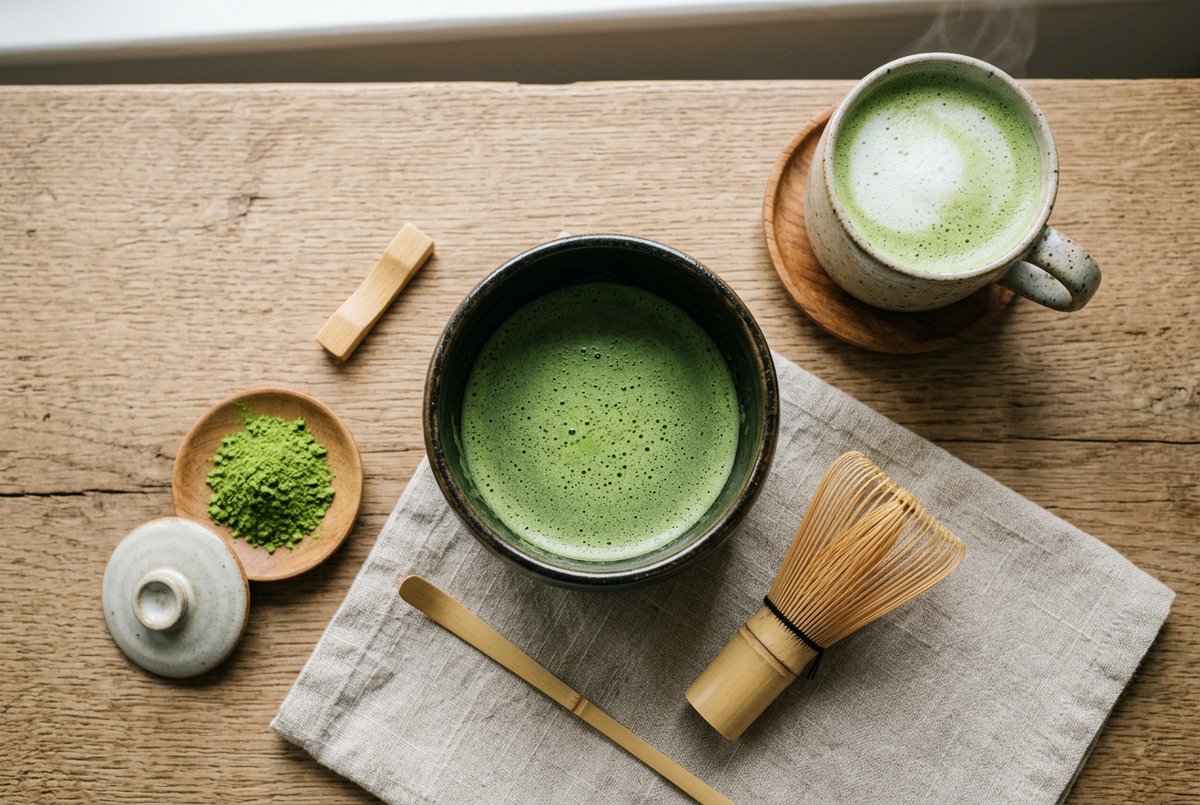
Green Zen is our certified organic, ceremonial-grade matcha, shade-grown for more L-theanine and a smooth, naturally sweet taste. Swap your second coffee for it and feel the difference. How to prepare it: How to Make Matcha.
The Avodah Moment: Energy Without the Edge
Avodah means devotion and service. Most of us reach for caffeine so we can keep giving: to work, to family, to everyone who needs us. Matcha lets you do that without running on nerves.
Tomorrow morning, whisk a bowl instead of rushing a coffee. Watch the foam rise. Breathe in its fresh, grassy sweetness. Drink it slowly, and start the day steady.
You cannot pour from an empty cup. This is where you fill yours.
More: Matcha Benefits
Frequently Asked Questions
Does matcha have caffeine?
Yes. About 60 to 70 mg per teaspoon (2 g), less than a mug of coffee (about 95 mg).
How much caffeine is in a matcha latte?
Usually 60 to 140 mg, depending on whether it uses 1 or 2 teaspoons of matcha.
Does matcha have more caffeine than coffee?
Usually not per serving. A strong latte with 2 or more teaspoons can match it.
Why does matcha not make me jittery like coffee?
Matcha contains L-theanine, which, in clinical trials, smoothed caffeine into calm, focused alertness.
Does matcha have more caffeine than green tea?
Yes. You drink the whole leaf, and shade-growing increases its caffeine.
Can I drink matcha at night?
It is best not to. Choose a caffeine-free herbal tea after about 2 pm.
Your day. Your tea. Your Avodah Moment.
References
1. Juneja LR, Chu DC, Okubo T, Nagato Y, Yokogoshi H. L-theanine: a unique amino acid of green tea and its relaxation effect in humans. Trends Food Sci Technol. 1999;10(6-7):199-204.
2. Owen GN, Parnell H, De Bruin EA, Rycroft JA. The combined effects of L-theanine and caffeine on cognitive performance and mood. Nutr Neurosci. 2008;11(4):193-198.
3. Ku KM, Choi JN, Kim J, et al. Metabolomics analysis reveals the compositional differences of shade-grown tea (Camellia sinensis L.). J Agric Food Chem. 2010;58(1):418-426.
4. Weiss DJ, Anderton CR. Determination of catechins in matcha green tea by micellar electrokinetic chromatography. J Chromatogr A. 2003;1011(1-2):173-180.
5. Haskell CF, Kennedy DO, Milne AL, Wesnes KA, Scholey AB. The effects of L-theanine, caffeine and their combination on cognition and mood. Biol Psychol. 2008;77(2):113-122.
6. Institute of Medicine (US) Committee on Military Nutrition Research. Caffeine for the Sustainment of Mental Task Performance. Washington (DC): National Academies Press; 2001.
7. Health Canada. Caffeine in Food. Government of Canada.



%20contains%20roughly%2060%20to%2070%20mg%20of%20caffeine,%20more%20than%20a%20cup%20of%20steeped%20green%20tea%20but%20less%20than%20a%20mug%20of%20brewed%20coffee%20(about%2095%20...)
Leave a comment
This site is protected by hCaptcha and the hCaptcha Privacy Policy and Terms of Service apply.