Caffeine in Tea Explained: How Much Is in Your Cup
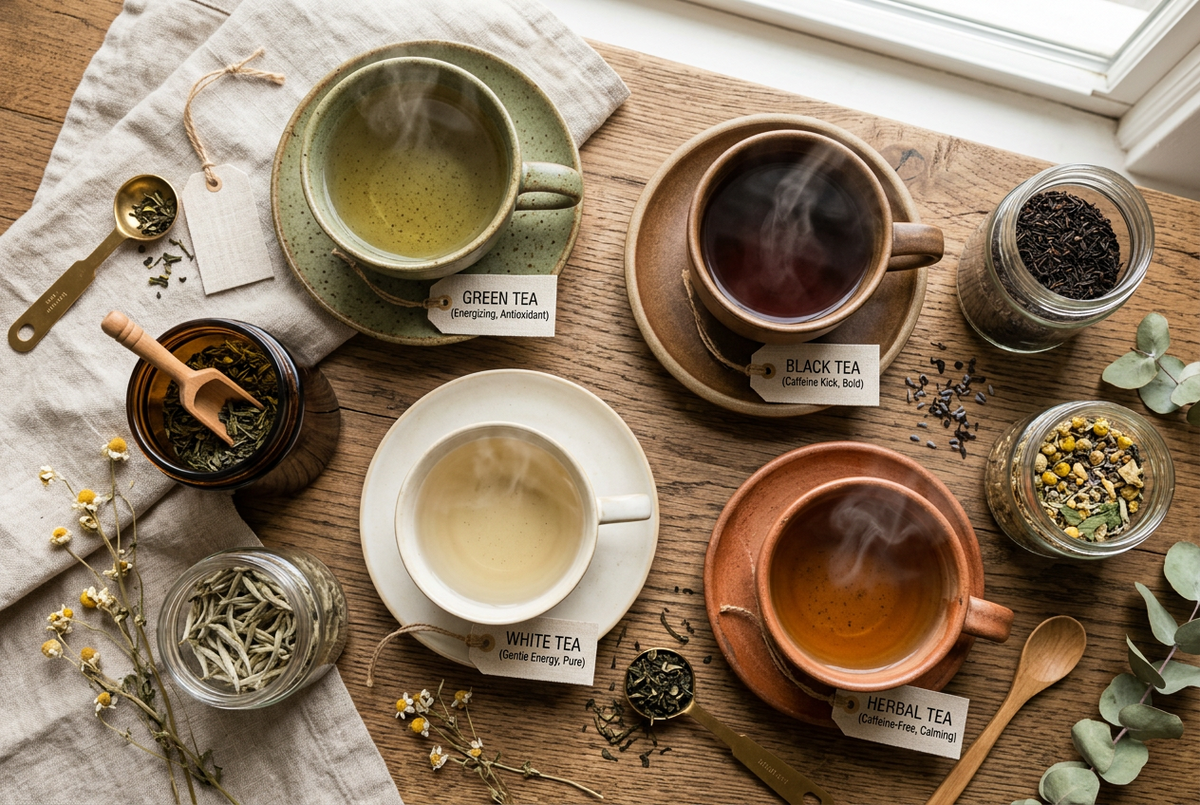
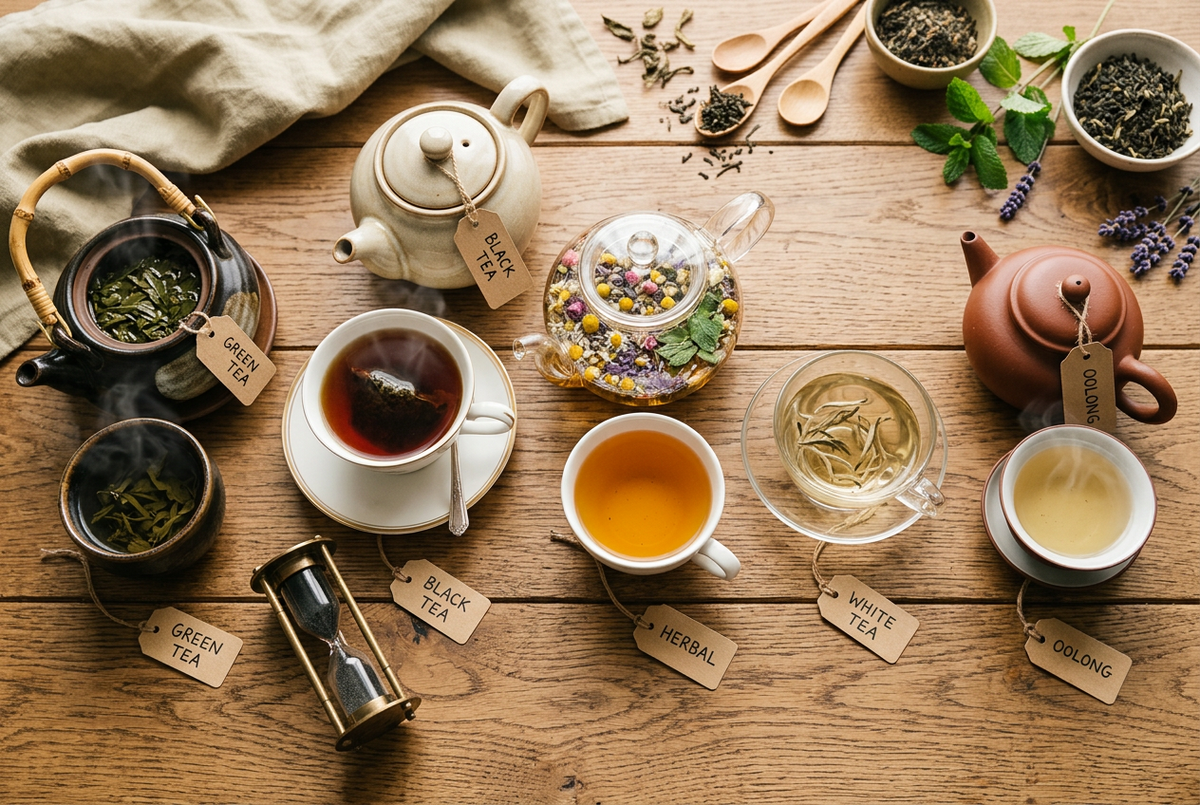
Yes, true teas contain caffeine because black, green, oolong, and white tea all come from one plant, Camellia sinensis. Black tea has the most, roughly 40 to 70 mg per cup; white tea has the least. Herbal teas such as chamomile, peppermint, and rooibos are naturally caffeine-free because they do not come from the tea plant at all.
And here is what makes tea different from coffee: tea's caffeine arrives with L-theanine, an amino acid found almost only in the tea plant. In randomized trials, the combination of caffeine and L-theanine improved focus and attention more consistently than caffeine alone. [1] [2] That is why a cup of tea lifts you without the jolt.
How Much Caffeine Is in Tea? Chart by Type
|
Drink (per 8 oz / 240 ml cup) |
Caffeine |
Notes |
|
Brewed coffee |
~95 mg |
For comparison |
|
Matcha (1 tsp / 2 g) |
60 to 70 mg |
You drink the whole leaf |
|
Black tea |
40 to 70 mg |
Highest of the steeped true teas |
|
Oolong tea |
30 to 50 mg |
Between green and black |
|
Green tea |
25 to 45 mg |
A gentler lift |
|
White tea |
15 to 30 mg |
Least of the true teas |
|
Decaf tea |
2 to 5 mg |
Traces remain |
|
Herbal tea/tisane |
0 mg |
Naturally caffeine-free |
These are ranges, not fixed numbers. When researchers measured brewed teas, caffeine ranged from about 14 to 61 mg per 6 oz serving, depending on the tea and how it was brewed. [3] [4] Three things change the caffeine in your cup:
- Leaf amount: more leaf, more caffeine.
- Water temperature: hotter water extracts more.
- Steep time: longer steeps extract more. [5]
Which Teas Are Caffeine-Free?
Any tea that is not made from Camellia sinensis. These herbal teas, also called tisanes, are naturally caffeine-free:
- Chamomile: the classic bedtime cup. See Does Chamomile Tea Have Caffeine?
- Rooibos: rich and smooth like black tea, with zero caffeine. See Does Rooibos Tea Have Caffeine?
- Peppermint and spearmint
- Hibiscus
- Lemongrass, lemon balm, lavender and rose
- Valerian root
Caffeine-free Avodah blends: Sleep Restore, Quiet Mind and Serene Tranquility. All three are 100% herbal, made for afternoons and evenings. For the best bedtime options, see The Best Caffeine Free Teas for Sleep.
Is Every Herbal Tea Caffeine-Free?
Not quite. Read the blend, not just the word "herbal." Two exceptions:
- Blends with a tea base. Some "herbal" blends include green or black tea. Our Pure Detox, for example, contains green and black tea, so it contains caffeine.
- Naturally caffeinated plants. Yerba mate comes from a holly plant, not the tea plant, yet it naturally contains caffeine. [6] Cacao contains small amounts too.
The rule: if the label lists green tea, black tea, white tea, oolong, matcha, yerba mate, or guayusa, it contains caffeine.
Which Avodah Teas Contain Caffeine?
|
Blend |
Caffeine level |
Best time |
|
Green Zen (ceremonial matcha) |
Higher |
Morning |
|
Velvet Earl Grey (Ceylon black tea) |
Medium |
Morning to mid afternoon |
|
Lean Bloom (oolong + green tea) |
Low |
Morning, pre-walk or workout |
|
Pure Detox (green + black tea) |
Low |
Daytime |
|
Sleep Restore, Quiet Mind, Serene Tranquility |
None |
Any time, including bedtime |
Tea Caffeine vs Coffee Caffeine: Why Tea Feels Different
It is the same caffeine molecule, but tea brings a partner: L-theanine.
L-theanine increases alpha brain waves, the pattern of calm, relaxed alertness, within about 40 minutes. [7] In randomized trials, L-theanine and caffeine together improved attention, task switching, and alertness while reducing distraction, compared with caffeine alone. [1] [2]
So tea gives you a steadier, smoother lift, while coffee hits harder and faster. Full comparison in Tea vs Coffee. For the calmest green tea, see Green Tea to Relax.
How Much Tea Can I Drink a Day?
Health Canada advises healthy adults to stay at or below 400 mg of caffeine a day, roughly six to eight cups of black or green tea. [8] If you are pregnant, breastfeeding, or planning a pregnancy, the limit is 300 mg a day. [8] The European Food Safety Authority sets the same 400 mg daily guideline for adults. [9]
Caffeine-free herbal blends add no caffeine at all, but each herb has its own guidance. For example, licorice root should be enjoyed in moderation and avoided in pregnancy. See Licorice Root Tea: Benefits and Safety.
Can I Drink Tea Before Bed?
Yes, if it is caffeine-free. Caffeine's half-life is about 5 hours, so half of an afternoon cup is still in your system at dinner. [10] In a sleep study, caffeine taken even six hours before bed cut more than an hour from total sleep. [11]
The simple rule: caffeinated tea before about 2 pm; caffeine-free herbal tea after. Our caffeine-free Sleep Restore is made for bedtime.
How to Lower the Caffeine in Your Tea
- Steep for less time. Most caffeine releases in the first few minutes. [5]
- Use cooler water. Cooler water extracts less caffeine.
- Cold brew it. Cold water extracts caffeine more slowly. See How to Make Iced Tea and Cold Brew Tea.
- Switch to a caffeine-free herbal blend in the afternoon and evening.
Myth: "a 30-second rinse removes most of the caffeine." It does not. When researchers tested it, a quick rinse removed only a small fraction of the caffeine, about 9%. [12] It is not worth wasting the first infusion.
Does Decaf Tea Have Zero Caffeine?
No. Decaffeinated tea starts as caffeinated tea and keeps a trace, usually 2 to 5 mg per cup. For a true zero, choose a naturally caffeine-free herbal tea.
Feeling Over-Caffeinated?
Shaky hands, a racing heart, or an anxious edge are signs you have had too much. Here is what to do: How to Get Rid of Caffeine Jitters.
The Avodah Moment: Choose the Cup That Fits the Hour
Avodah means devotion and service. Your day asks different things of you at different hours, and your tea can follow along.
In the morning, a cup with caffeine and L-theanine for calm, clear focus. After lunch, something lighter. And as the day winds down, a caffeine-free cup that lets your body slow down with you. Make the switch on purpose: brew it, cover it, breathe while it steeps, and let the evening cup mark the end of the work.
You cannot pour from an empty cup. This is where you fill yours.
Shop Caffeine-Free Herbal Teas | Shop Green Zen Matcha
Frequently Asked Questions
Does green tea have less caffeine than black tea?
Usually. Green tea has about 25 to 45 mg per cup and black tea about 40 to 70 mg, though leaf amount and steep time shift both.
Which tea has the most caffeine?
Matcha, because you drink the whole leaf, followed by black tea. White tea has the least of the true teas.
Does herbal tea have caffeine?
Pure herbal teas such as chamomile, rooibos, and peppermint have none. Check the label for green tea, black tea, yerba mate, or guayusa.
Is tea caffeine different from coffee caffeine?
It is the same molecule, but tea also contains L-theanine, which in clinical trials smoothed caffeine into calmer, more focused alertness.
Does decaf tea have zero caffeine?
No. It usually contains 2 to 5 mg per cup. For zero, choose a naturally caffeine-free herbal tea.
Does iced tea have caffeine?
If it is made from true tea, yes. Iced herbal tea is caffeine-free.
How much tea can I drink a day?
Health Canada advises most adults to stay at or below 400 mg of caffeine a day, about six to eight cups of tea, and 300 mg in pregnancy.
Does rinsing tea remove the caffeine?
No. A quick rinse removes only about 9% of the caffeine.
Can I drink tea before bed?
Yes, if it is a caffeine-free herbal blend. Save caffeinated tea for before about 2 pm.
Your day. Your tea. Your Avodah Moment.
References
1. Owen GN, Parnell H, De Bruin EA, Rycroft JA. The combined effects of L-theanine and caffeine on cognitive performance and mood. Nutr Neurosci. 2008;11(4):193-198.
2. Haskell CF, Kennedy DO, Milne AL, Wesnes KA, Scholey AB. The effects of L-theanine, caffeine and their combination on cognition and mood. Biol Psychol. 2008;77(2):113-122.
3. Chin JM, Merves ML, Goldberger BA, Sampson-Cone A, Cone EJ. Caffeine content of brewed teas. J Anal Toxicol. 2008;32(8):702-704.
4. U.S. Department of Agriculture, Agricultural Research Service. FoodData Central: brewed coffee, brewed black tea, brewed green tea. https://fdc.nal.usda.gov/
5. Astill C, Birch MR, Dacombe C, Humphrey PG, Martin PT. Factors affecting the caffeine and polyphenol contents of black and green tea infusions. J Agric Food Chem. 2001;49(11):5340-5347.
6. Heck CI, de Mejia EG. Yerba Mate Tea (Ilex paraguariensis): a comprehensive review on chemistry, health implications, and technological considerations. J Food Sci. 2007;72(9):R138-R151.
7. Juneja LR, Chu DC, Okubo T, Nagato Y, Yokogoshi H. L-theanine: a unique amino acid of green tea and its relaxation effect in humans. Trends Food Sci Technol. 1999;10(6-7):199-204.
8. Health Canada. Caffeine in Food. Government of Canada.
9. EFSA Panel on Dietetic Products, Nutrition and Allergies. Scientific Opinion on the safety of caffeine. EFSA Journal. 2015;13(5):4102.
10. Institute of Medicine (US) Committee on Military Nutrition Research. Caffeine for the Sustainment of Mental Task Performance. Washington (DC): National Academies Press; 2001.
11. Drake C, Roehrs T, Shambroom J, Roth T. Caffeine effects on sleep taken 0, 3, or 6 hours before going to bed. J Clin Sleep Med. 2013;9(11):1195-1200.
12. Hicks MB, Hsieh YHP, Bell LN. Tea preparation and its influence on methylxanthine concentration. Food Res Int. 1996;29(3-4):325-330.
*These statements have not been evaluated by the Food and Drug Administration or Health Canada. Avodah teas are not intended to diagnose, treat, cure or prevent any disease. If you are pregnant, nursing, taking medication or managing a health condition, speak with your healthcare provider before adding a new herbal tea to your routine.


Leave a comment
This site is protected by hCaptcha and the hCaptcha Privacy Policy and Terms of Service apply.