

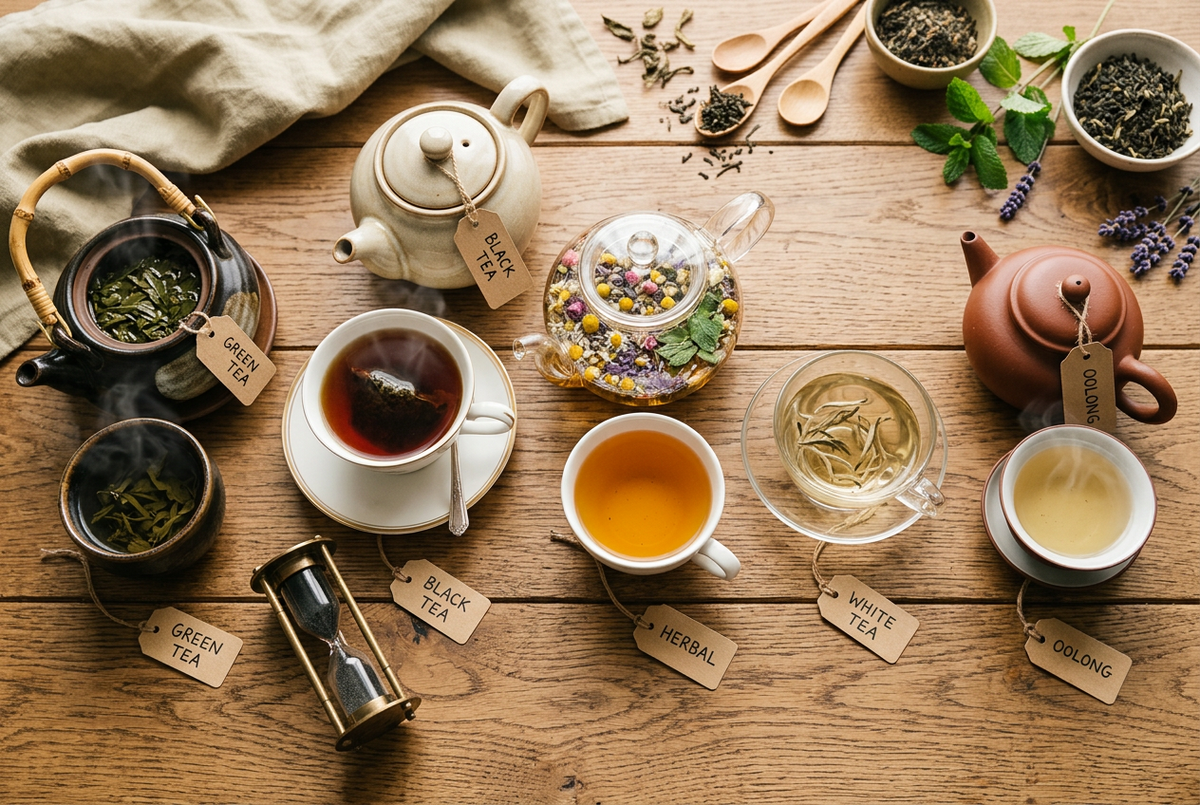
How Long to Steep Tea: Water Temperature and Steep Time Chart
Steep green and white tea for 1 to 3 minutes in water around 80°C (175°F). Steep oolong, black, and pu-erh for 3 to 5 minutes in water at 95 to 100°C (205 to 212°F). Steep herbal teas and rooibos for 5 to 7 minutes in fully boiling water. Too long or too hot, and true teas turn bitter. The complete chart is below.
Two things decide whether your cup tastes bright or bitter: temperature and time. Research on tea infusions shows both directly control how much caffeine and how many polyphenols, the antioxidant compounds tea is famous for, move from the leaf into your cup. [1] Get those two right and everything else gets easy.
Tea Steeping Time and Water Temperature Chart
|
Tea type |
Water temperature |
Steep time |
What to know |
|
Green tea |
75 to 85°C / 167 to 185°F |
1 to 3 minutes |
Cooler water keeps it sweet, not bitter |
|
White tea |
80 to 85°C / 175 to 185°F |
2 to 5 minutes |
Delicate and forgiving |
|
Oolong tea |
85 to 95°C / 185 to 205°F |
3 to 5 minutes |
Re-steeps beautifully, 2 to 3 times |
|
Black tea |
95 to 100°C / 205 to 212°F |
3 to 5 minutes |
Full boil brings out its body |
|
Pu-erh tea |
95 to 100°C / 205 to 212°F |
3 to 5 minutes |
Rinse the leaves briefly first |
|
Herbal tea |
100°C / 212°F |
5 to 7 minutes |
Roots, flowers and seeds need longer |
|
Rooibos |
100°C / 212°F |
5 to 7 minutes |
Naturally caffeine-free, hard to over-steep |
|
Matcha |
70 to 80°C / 158 to 175°F |
No steep |
Whisked into the water, never boiled |
Start at the shorter end of the range. You can always steep your next cup longer; you cannot un-steep a bitter one. When your blend has its own instructions, follow those first.
Why Do Steep Time and Water Temperature Matter?
Steeping is extraction. The moment hot water touches tea leaves, flowers, or roots, it begins pulling out aroma, color, flavor, and plant compounds.
- Temperature controls speed. Hotter water extracts compounds faster.
- Time controls quantity. The longer the steep, the more the water pulls out.
In true teas, the first minutes release the bright aromatics, catechins, and caffeine. Push past the sweet spot, especially with green tea, and you also pull out more tannins: the compounds that taste bitter and leave your mouth feeling dry. [1] [2]
Herbal blends behave differently. They contain no tea tannins and no caffeine, and their ingredients range from soft petals to dense roots and spices that need time and heat to open. That is why there is no single steep time for every tea.
How Long Should You Steep Green Tea?
1 to 3 minutes at 75 to 85°C (167 to 185°F). Green tea is the easiest tea to scorch. Boiling water extracts its catechins so fast that the cup turns harsh and grassy. Cooler water keeps it sweet and lets its calming amino acid, L-theanine, shine. [2]
If your green tea tastes bitter, try cooler water first, then a shorter steep. For matcha-style calm focus, see Green Tea to Relax.
How Long Should You Steep Black Tea?
3 to 5 minutes at 95 to 100°C (205 to 212°F). Black tea is fully oxidized and loves a full boil, which unlocks its rich body and its theaflavins, the antioxidants behind its coppery color. A shorter steep gives a lighter cup; a longer one gives a bolder cup to stand up to milk.
Add milk after brewing, not before. The leaves need direct contact with hot water to be fully extracted. Try it with our whole-leaf Ceylon Velvet Earl Grey.
How Long Should You Steep White Tea?
2 to 5 minutes at 80 to 85°C (175 to 185°F). White tea is the least processed of all teas, with a delicate, honeyed flavor. Boiling water can flatten it. Its large, fluffy leaves are forgiving, so a slightly longer steep rarely turns bitter.
How Long Should You Steep Oolong Tea?
3 to 5 minutes at 85 to 95°C (185 to 205°F). Oolong ranges from light and floral to dark and roasted, so lighter oolongs prefer the cooler end. Oolong is the king of re-steeping: its rolled leaves open more with each infusion, giving 2 to 3 delicious cups. Try our Ti Kuan Yin oolong blend, Lean Bloom.
How Long Should You Steep Herbal Tea?
5 to 7 minutes in fully boiling water, covered. Herbal blends contain flowers, leaves, roots, fruit, seeds, and spices, and each releases its compounds at a different speed. Dense roots like valerian and licorice need the full time and full heat.
Cover your cup. Many of the calming compounds in chamomile, lavender and mint live in their aromatic oils. A lid keeps them in your tea instead of in the steam.
Our herbal blends, including Sleep Restore, Quiet Mind and Serene Tranquility, are built for this: just-boiled water, covered, 5 to 7 minutes.
How Long Should You Steep Rooibos Tea?
5 to 7 minutes in boiling water, or longer. Rooibos is naturally caffeine-free and low in tannins, so it does not turn bitter. A longer steep simply makes it richer and sweeter. [3] Rooibos is the base of Quiet Mind, Serene Tranquility, and Belly Balance.
Do You Steep Matcha?
No. Matcha is whisked, not steeped. You drink the whole powdered leaf, so there is nothing to remove. Use water at 70 to 80°C (158 to 175°F); boiling water makes matcha bitter. Whisk briskly in a "W" motion until frothy. Try our ceremonial grade Green Zen.
What Happens If You Steep Tea Too Long?
True teas turn bitter and astringent. Over-steeping pulls out extra tannins, which taste harsh and dry the mouth. [1] Your tea becomes:
- stronger
- more bitter
- more astringent
- less balanced
Herbal blends are far more forgiving. Rooibos and most herbal teas stay smooth even after a long steep.
Why Does My Tea Taste Bitter?
Four common causes, and four easy fixes:
- The water is too hot. Most common with green and white tea. Let boiled water rest for a minute or two.
- You steeped it too long. Set a timer and lift the leaves out on time.
- You used too much tea. More leaf means faster, stronger extraction.
- The tea is naturally brisk. Some black teas are bold by design. Add milk or shorten the steep.
Change one thing at a time so you know what fixed it. Full brewing method in How to Brew Loose Leaf Tea.
Why Does My Tea Taste Weak?
Usually the opposite problems: too little tea, water that was not hot enough, leaves removed too early, or an infuser so cramped the water could not circulate. Check the amount and temperature before doubling the steep time. See How to Use a Tea Infuser for picking an infuser with room to brew.
Does Steeping Tea Longer Increase Caffeine?
Yes. Hotter water and longer steeps extract more caffeine from true tea. [1] Leaf size, leaf amount, and tea type matter too. A shorter steep lowers the caffeine, but it never makes a caffeinated tea caffeine-free. For the full breakdown, read Caffeine in Tea Explained.
Do You Need a Thermometer to Make Tea?
No. A variable temperature kettle helps, but a simple rule works:
- Black, herbal, rooibos: pour at a full boil.
- Oolong: let boiled water rest about 1 minute.
- Green and white: let it rest 2 to 3 minutes.
Should You Cover Tea While It Steeps?
Yes, especially herbal tea. Covering keeps the heat in and the aromatic oils in your cup instead of drifting away in the steam. An infuser mug with a lid makes it effortless. See How to Use Your Avodah Infuser Mug.
When Should You Remove the Tea Infuser?
As soon as the steep time is up. Leaving the infuser in means the tea keeps brewing, which quickly changes the taste of delicate true teas. With herbal blends, the change is gentler, but removing the leaves still gives you control over the final cup.
Does Water Quality Affect Your Tea?
Yes. Tea is about 99% water, so the water shapes every cup.
- Use fresh, cold water each time. Water boiled again and again tastes flat.
- Very hard water can dull tea's flavor and leave a film on the surface of black tea. A simple filter jug helps.
- Avoid distilled water. With no minerals at all, tea tastes hollow.
If your tea tastes flat no matter what you do, try filtered water before changing anything else.
How to Steep Tea for Multiple Infusions
Great loose leaf can give you two, three or more cups from the same leaves. Oolong and green teas are best for this.
- Brew your first cup for the shorter end of the recommended time.
- Keep the wet leaves in the infuser, lifted out of the water.
- For each new cup, use the same water temperature and add 30 seconds to 1 minute.
Each infusion reveals new flavors as the leaves open further. Herbal blends with flowers and roots usually give their best in the first cup.
The Avodah Moment: Two Minutes or Seven, They Are Yours
Avodah means devotion and service. Every steep time on this chart is a small, built-in pause: two minutes for green, five for black, seven for a calming herbal blend.
Use them. Do not fill the wait with your phone or one more task. Stand by the window. Breathe in for four, out for six. Watch the water turn from clear to gold. When the timer sounds, lift the leaves, wrap your hands around the cup, and take that first sip slowly.
You cannot pour from an empty cup. These few minutes are where you fill yours.
Frequently Asked Questions About Tea Steeping Times
How long should tea steep?
Green tea: 1 to 3 minutes; white tea: 2 to 5 minutes; oolong and black tea: 3 to 5 minutes; and herbal tea and rooibos: 5 to 7 minutes.
How long should you steep green tea?
1 to 3 minutes at 75 to 85°C (167 to 185°F). If it tastes bitter, use cooler water or a shorter steep.
How long should you steep black tea?
3 to 5 minutes in water at 95 to 100°C (205 to 212°F). Steep toward 5 minutes if you add milk.
How long should you steep herbal tea?
5 to 7 minutes in fully boiling water, covered to keep the aromatic oils in your cup.
Can you steep tea too long?
Yes. True teas turn bitter and astringent as extra tannins are released. Herbal teas and rooibos are much more forgiving.
What temperature should water be for tea?
Green and white tea 75 to 85°C, oolong 85 to 95°C, and black, herbal and rooibos tea at or near 100°C.
Should you use boiling water for green tea?
No. Boiling water scorches green tea and makes it bitter. Let it rest 2 to 3 minutes off the boil.
Does steeping tea longer increase caffeine?
Yes. Longer, hotter steeps extract more caffeine from true tea, though leaf amount and type matter too.
A Better Cup Starts With Two Things
- Temperature.
- Time.
Get those two right, and the rest is easy. Then all that is left is the part that matters most: finding a few minutes to enjoy it.
Explore Avodah Herbal Teas | Explore More Tea 101 Guides
Your day. Your tea. Your Avodah Moment.
References
1. Astill C, Birch MR, Dacombe C, Humphrey PG, Martin PT. Factors affecting the caffeine and polyphenol contents of black and green tea infusions. J Agric Food Chem. 2001;49(11):5340-5347.
2. Juneja LR, Chu DC, Okubo T, Nagato Y, Yokogoshi H. L-theanine: a unique amino acid of green tea and its relaxation effect in humans. Trends Food Sci Technol. 1999;10(6-7):199-204.
3. Joubert E, de Beer D. Rooibos (Aspalathus linearis) beyond the farm gate: from herbal tea to potential phytopharmaceutical. S Afr J Bot. 2011;77(4):869-886.
*These statements have not been evaluated by the Food and Drug Administration or Health Canada. Avodah teas are not intended to diagnose, treat, cure or prevent any disease. If you are pregnant, nursing, taking medication or managing a health condition, speak with your healthcare provider before adding a new herbal tea to your routine.


Leave a comment
This site is protected by hCaptcha and the hCaptcha Privacy Policy and Terms of Service apply.