

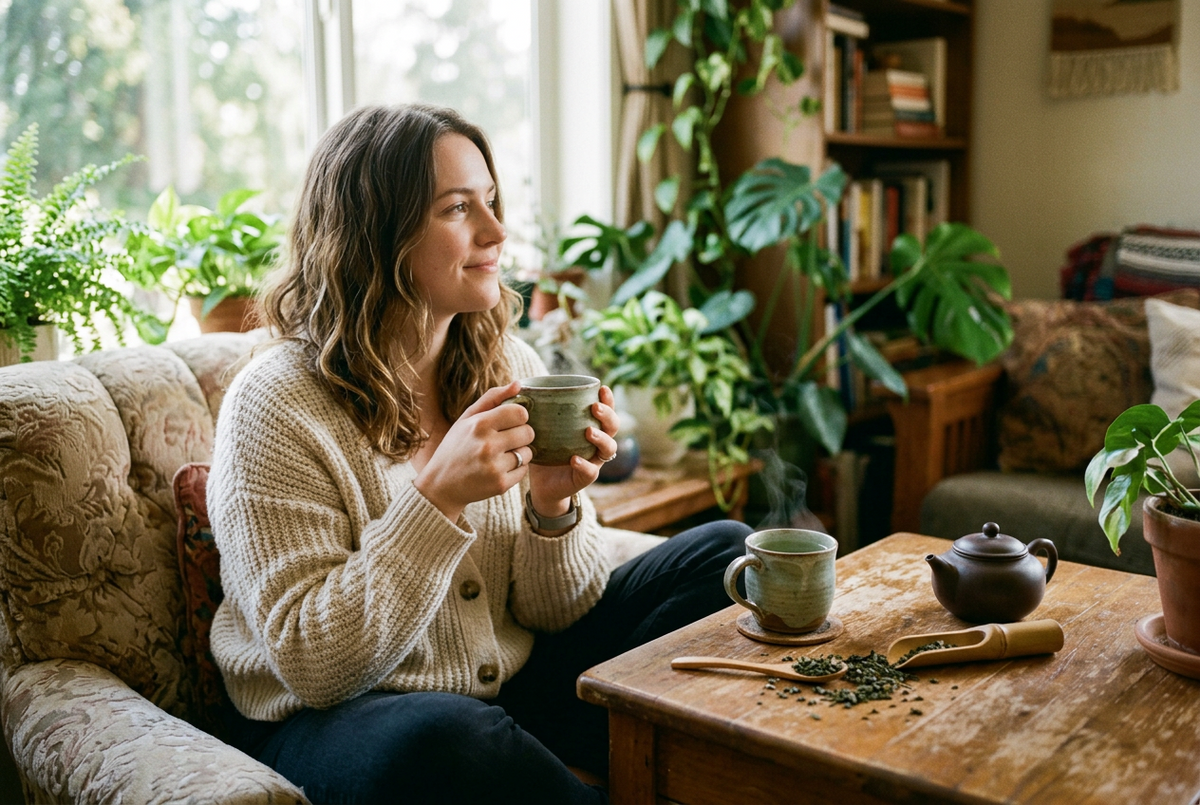
Green Tea to Relax: How L-Theanine Creates Calm Focus
Yes, green tea relaxes you without making you drowsy. Its unique amino acid, L-theanine, increases alpha brain waves, the pattern linked to relaxed alertness, within about 40 minutes of drinking it.
That is what makes green tea different from every other calming drink. Chamomile and lavender wind you down. Green tea calms you and keeps you sharp. It is the tea for the stressful workday, the busy afternoon, and the moment you need to think clearly without feeling frazzled.
Here is how it works; which green teas are the most relaxing, and how to brew them for maximum calm.
How Green Tea Relaxes You: Meet L-Theanine
L-theanine is an amino acid found almost exclusively in the tea plant, Camellia sinensis. It crosses into the brain, where it does three calming things:
- Increases alpha brain waves. Alpha waves are the brain's "wakeful relaxation" pattern, the state you are in during meditation or a quiet, focused moment. In human studies, L-theanine increased alpha wave activity within about 40 minutes.* [1]
- Supports calming neurotransmitters. L-theanine influences GABA, serotonin, and dopamine, brain chemicals that help balance mood and promote calm.* [1]
- Softens the stress response. In a placebo-controlled study, L-theanine reduced heart rate and stress markers during a demanding mental task.* [2]
The result is a feeling tea drinkers have described for centuries: calm, clear, and present.
Green Tea, Caffeine, and Calm: Why It Works Together
Green tea contains caffeine, and that is part of its magic. On its own, caffeine can tip you into jitters. Paired with L-theanine, it becomes something different: steady, focused energy without the crash.
- In a randomized trial, the combination of L-theanine and caffeine improved both the speed and accuracy of attention switching and reduced distraction.* [4]
- In another randomized trial, four weeks of L-theanine reduced stress-related symptoms and improved sleep quality in healthy adults.* [3]
That is why monks have sipped green tea to stay calm and alert through long hours of meditation for more than a thousand years.
The Most Relaxing Green Teas
1. Matcha: The Most Relaxing Green Tea
Matcha is the richest source of L-theanine you can drink.* The tea plants are shaded for weeks before harvest, which boosts L-theanine, and you drink the whole powdered leaf instead of an infusion. Research on matcha found it reduced stress responses in both animal and human studies, with the effect linked to its high L-theanine content.* [5]
Find it in: Green Zen Tea, our ceremonial grade matcha.
2. Oolong: Smooth, Floral Calm
Oolong sits between green and black tea, with a rounder, more mellow flavor. It contains L-theanine and the antioxidant polyphenols of the tea plant, and its floral notes make it a deeply calming cup.*
Find it in: Lean Bloom Tea, our Ti Kuan Yin oolong and green tea blend with petals and a hint of bergamot. Bergamot's aroma is calming too: in a study of 41 women, inhaling bergamot lowered salivary cortisol and improved mood.* [6]
3. Sencha and Gyokuro
Japanese steamed green teas have a fresh, grassy sweetness. Gyokuro is shade-grown like matcha, so it is especially high in L-theanine.*
4. Decaf Green Tea
For evenings, a decaf green tea gives you the ritual with minimal caffeine. For a completely caffeine-free calming cup, choose lavender or rooibos instead, like our Quiet Mind Tea.
How to Brew Green Tea for Maximum Calm
Cooler water and a shorter steep give you a sweeter, more relaxing cup. Boiling water scorches green tea, releasing bitter tannins and masking the gentle sweetness of L-theanine.
Loose Leaf Green Tea or Oolong
1. Heat water to 70 to 80°C (160 to 175°F), or let boiled water rest for 2 to 3 minutes.
2. Use 1 teaspoon of leaves per 250 ml cup.
3. Steep green tea for 2 to 3 minutes, oolong for 3 to 5 minutes.
4. Re-steep: good oolong and green leaves give two or three delicious cups.
Matcha
1. Sift 1 teaspoon (about 2 g) of matcha into a bowl.
2. Add 60 ml of water at about 75 to 80°C (165 to 175°F).
3. Whisk briskly in a "W" motion for 15 to 20 seconds until frothy.
4. Top up with more hot water or warm milk for a matcha latte.
When to Drink Green Tea to Relax
Drink green tea in the morning or early afternoon for calm focus. Because it contains caffeine, finish your last cup by about 2 pm so it does not affect your sleep. Perfect moments:
- Before a stressful meeting or exam: about 40 minutes ahead, when L-theanine's alpha wave effect peaks.* [1]
- As your mid-morning coffee replacement: smoother energy without the jitters.*
- During a work or study session: calm, sustained attention.* [4]
From mid-afternoon, switch to a caffeine-free calming tea. The Midday Reset bundle does exactly that: Lean Bloom for focus, Belly Balance after lunch, and caffeine-free Quiet Mind for the afternoon.
Green Tea vs Chamomile for Relaxation
|
|
Green Tea / Matcha |
Chamomile |
|
Key compound |
L-theanine |
Apigenin |
|
How it calms |
Alpha brain waves, relaxed focus* |
GABA-A receptors, gentle sedation* |
|
Feels like |
Calm and alert |
Calm and sleepy |
|
Caffeine |
Yes |
None |
|
Best time |
Morning to early afternoon |
Afternoon to bedtime |
For the full story on chamomile, read Chamomile and Lavender Tea.
The Avodah Moment: Calm in the Middle of the Day
Avodah means devotion and service. The middle of the day is when your devotion is stretched the thinnest: meetings, messages, deadlines, and people who need you right now.
That is exactly when a green tea moment matters most. Step away from the screen. Whisk your Green Zen matcha until it froths, or watch your Lean Bloom leaves unfurl in the cup. Breathe slowly while it cools to sipping temperature. Then drink it, all of it, before you go back. Calm and clear is how you serve best.
You cannot pour from an empty cup. This is where you fill yours.
Shop Green Zen Tea | Shop Lean Bloom Tea
Good to Know
Green tea contains caffeine, so enjoy it earlier in the day and keep total caffeine moderate. If you are pregnant, breastfeeding, or sensitive to caffeine, check with your healthcare provider about how much is right for you.
Frequently Asked Questions
Does green tea relax you?
Yes. Its L-theanine increases calming alpha brain waves within about 40 minutes, creating relaxed alertness rather than drowsiness.*
What is the most relaxing green tea?
Matcha, because shade-growing boosts its L-theanine, and you drink the whole leaf. Gyokuro is a close second.*
Is green tea good for anxiety?
Yes, for daytime calm. L-theanine reduced stress-related symptoms in a randomized trial and balances caffeine's edge.* For evenings, choose caffeine-free lavender or rooibos.
Does green tea make you sleepy?
No. L-theanine relaxes you without sedation, and green tea's caffeine keeps you alert. It is calm focus, not drowsiness.*
When should I drink green tea to relax?
In the morning or early afternoon, about 40 minutes before you need to feel calm and focused. Finish your last cup by about 2 pm.
Does matcha calm you down?
Yes. Matcha is the richest drinkable source of L-theanine, and research links it to reduced stress responses.*
Can I drink green tea before bed?
It is best not to, because it contains caffeine. Choose a caffeine-free calming tea like Quiet Mind or Sleep Restore in the evening.
References
1. Juneja LR, Chu DC, Okubo T, Nagato Y, Yokogoshi H. L-theanine: a unique amino acid of green tea and its relaxation effect in humans. Trends Food Sci Technol. 1999;10(6-7):199-204.
2. Kimura K, Ozeki M, Juneja LR, Ohira H. L-Theanine reduces psychological and physiological stress responses. Biol Psychol. 2007;74(1):39-45.
3. Hidese S, Ogawa S, Ota M, et al. Effects of L-theanine administration on stress-related symptoms and cognitive functions in healthy adults: a randomized controlled trial. Nutrients. 2019;11(10):2362.
4. Owen GN, Parnell H, De Bruin EA, Rycroft JA. The combined effects of L-theanine and caffeine on cognitive performance and mood. Nutr Neurosci. 2008;11(4):193-198.
5. Unno K, Furushima D, Hamamoto S, et al. Stress-reducing function of matcha green tea in animal experiments and clinical trials. Nutrients. 2018;10(10):1468.
6. Watanabe E, Kuchta K, Kimura M, Rauwald HW, Kamei T, Imanishi J. Effects of bergamot (Citrus bergamia (Risso) Wright & Arn.) essential oil aromatherapy on mood states, parasympathetic nervous system activity, and salivary cortisol levels in 41 healthy females. Forsch Komplementmed. 2015;22(1):43-49.
*These statements have not been evaluated by the Food and Drug Administration or Health Canada. Avodah teas are not intended to diagnose, treat, cure, or prevent any disease. If you are pregnant, nursing, taking medication or managing a health condition, speak with your healthcare provider before adding a new herbal tea to your routine.


Leave a comment
This site is protected by hCaptcha and the hCaptcha Privacy Policy and Terms of Service apply.