

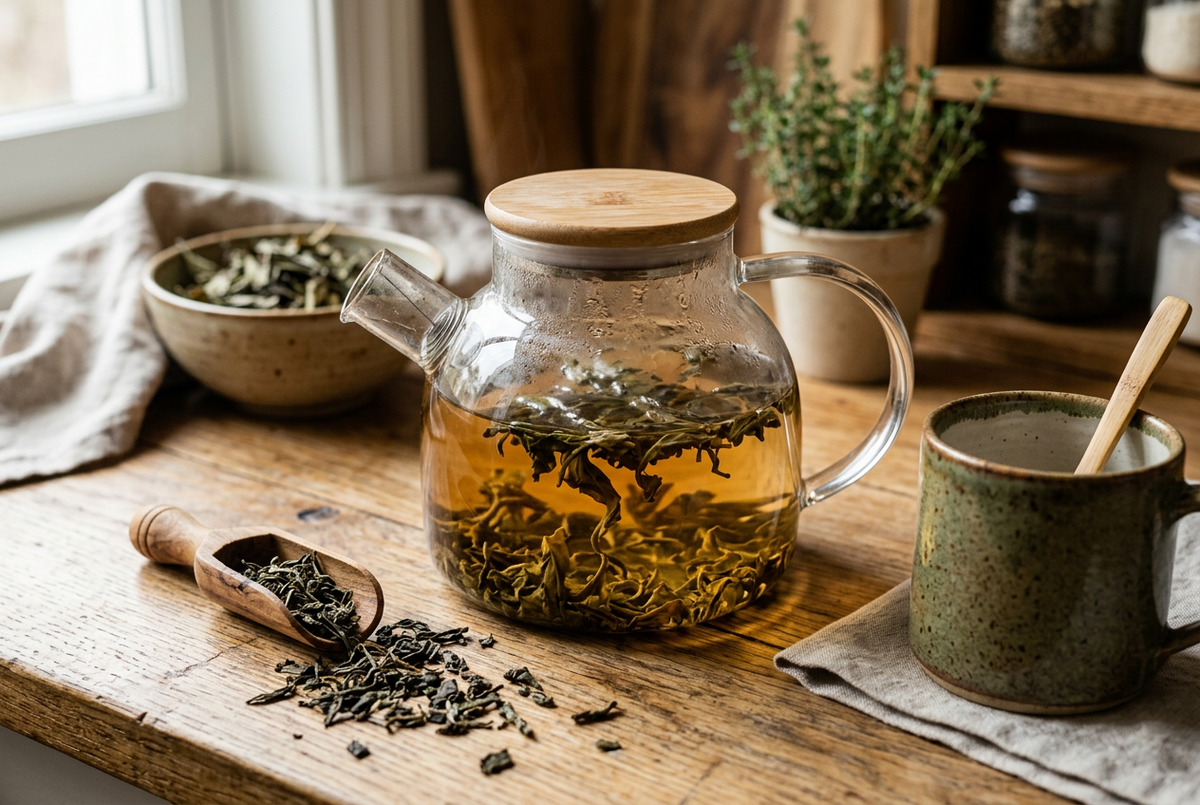
How to Brew Loose Leaf Tea: A Simple Step by Step Guide
To brew loose-leaf tea, use one heaped teaspoon of leaves per 8 oz cup, pour water at the right temperature for your tea, steep for the right time, then lift the leaves out. Herbal and black teas take boiling water and 3 to 7 minutes; green and white teas want cooler water and a shorter steep. That is the whole method. The details below are what turn a good cup into a great one.
Loose leaf is worth the extra thirty seconds. Whole leaves have room to unfurl and release their full flavor, aroma, and plant compounds. Research on tea infusions confirms that leaf size, water temperature, and steep time all change how much of a tea's polyphenols and caffeine end up in your cup. [1] When you brew loose leaf, you control all three.
What Do You Need to Make Loose Leaf Tea?
You do not need a complicated setup. For a simple cup:
- Loose leaf tea
- Fresh, cold water
- A mug or teapot
- A way to hold or strain the leaves: a roomy loose-leaf tea infuser, an infuser mug, or a small strainer
- A kettle
A roomy basket infuser is the best choice because it gives the leaves space to move as they steep. If you drink loose leaf every day, an infuser mug makes it effortless: you brew and drink from the same cup. New to infusers? Read How to Use a Tea Infuser.
How to Make Loose Leaf Tea in 5 Simple Steps
1. Start With Fresh Water
Tea is 99% water, so the water matters. Use fresh, cold water and heat only what you need. Water that has been boiled again and again loses dissolved oxygen and can taste flat.
The right temperature depends on your tea. Delicate green and white teas taste sweetest with cooler water, around 75 to 85°C (167 to 185°F). Black tea, rooibos, and herbal blends need water at or near a full boil. For every tea type, see our complete tea steeping time and water temperature chart.
2. Measure Your Loose Leaf Tea
Start with one heaped teaspoon, about 2 to 3 grams, per 8 oz (240 ml) cup.
Not every teaspoon weighs the same. A spoonful of dense black tea holds far more leaf than a spoonful of fluffy chamomile flowers or lemongrass. Use a slightly bigger spoon for light, fluffy herbs and a level spoon for dense, rolled leaves.
- Too weak? Use a little more leaf next time.
- Too strong? Use a little less.
Once you find your perfect amount, keep it consistent.
How much loose leaf tea for a large mug?
Scale up with the water. A 16 oz mug needs roughly twice the leaf of an 8 oz cup. Just do not pack the infuser tight: leaves need room to expand.
3. Put the Tea Into Your Infuser
Give the leaves space. Tea leaves absorb water and can expand to several times their dry size. Herbal blends contain flowers, fruit pieces, roots and spices that also need room. Water needs to circulate freely around every piece to extract it fully. That is why a roomy basket infuser beats a cramped tea ball every time.
4. Pour the Water and Let the Tea Steep
Pour the water directly over the leaves so all of them are submerged, then start the timer. The first minutes release aroma and the beneficial compounds. Steep too long, and true teas start releasing more tannins, the compounds that taste bitter and drying. [1]
Quick guide:
- Green and white tea: 1 to 3 minutes
- Oolong and black tea: 3 to 5 minutes
- Herbal teas and rooibos: 5 to 7 minutes
For the exact time and temperature for every tea type, use our steep time chart.
Pro tip for herbal blends: cover your cup. Many calming compounds in chamomile, lavender and mint live in their aromatic oils, the part you can smell. A lid or saucer keeps them in your tea instead of in the steam.
5. Remove the Leaves and Enjoy
When the time is up, lift the infuser out. This stops the brewing so your tea stays smooth. Let it cool to a comfortable sipping temperature and enjoy it as it is, or with a little honey, lemon or milk.
How Do You Make Loose Leaf Tea Without an Infuser?
Brew the leaves loose and strain them. Put the leaves directly into your mug or teapot, pour the water, steep, then pour the tea through a small kitchen strainer into another cup. A paper coffee filter or a clean cloth works too. An infuser makes loose leaf cleaner and easier, but it is not what makes loose leaf tea possible.
What Is the Difference Between an Infuser and a Strainer?
An infuser holds the leaves while they brew; a strainer catches them as you pour. If you brew one cup at a time, an infuser is the simplest choice. Full comparison in How to Use a Tea Infuser.
Can You Make Loose Leaf Tea in an Avodah Infuser Mug?
Yes, and it is the easiest way. Add your tea to the removable infuser, pour in water at the right temperature, steep, then lift the infuser out and drink from the same mug. Swap to the straw lid and the same mug makes iced tea and cold brew. Full instructions in How to Use Your Avodah Infuser Mug.
Can You Re-Steep Loose Leaf Tea?
Yes, and good loose leaf is made for it. Oolong, green, white, and whole-leaf black teas often give two or three excellent infusions, each one revealing new aromas. Add about a minute to each new steep. Re-steeping is one reason loose leaf costs less per cup than it looks.
Herbal blends that contain roots, fruit, and flowers usually give their best in the first cup. If the second cup still tastes good, enjoy it.
Can You Use Loose Leaf Tea to Make Iced Tea?
Absolutely. Brew it double strength and pour it over ice, or cold brew it in the fridge overnight for a smoother, naturally sweeter cup. Both methods in How to Make Iced Tea and Cold Brew Tea.
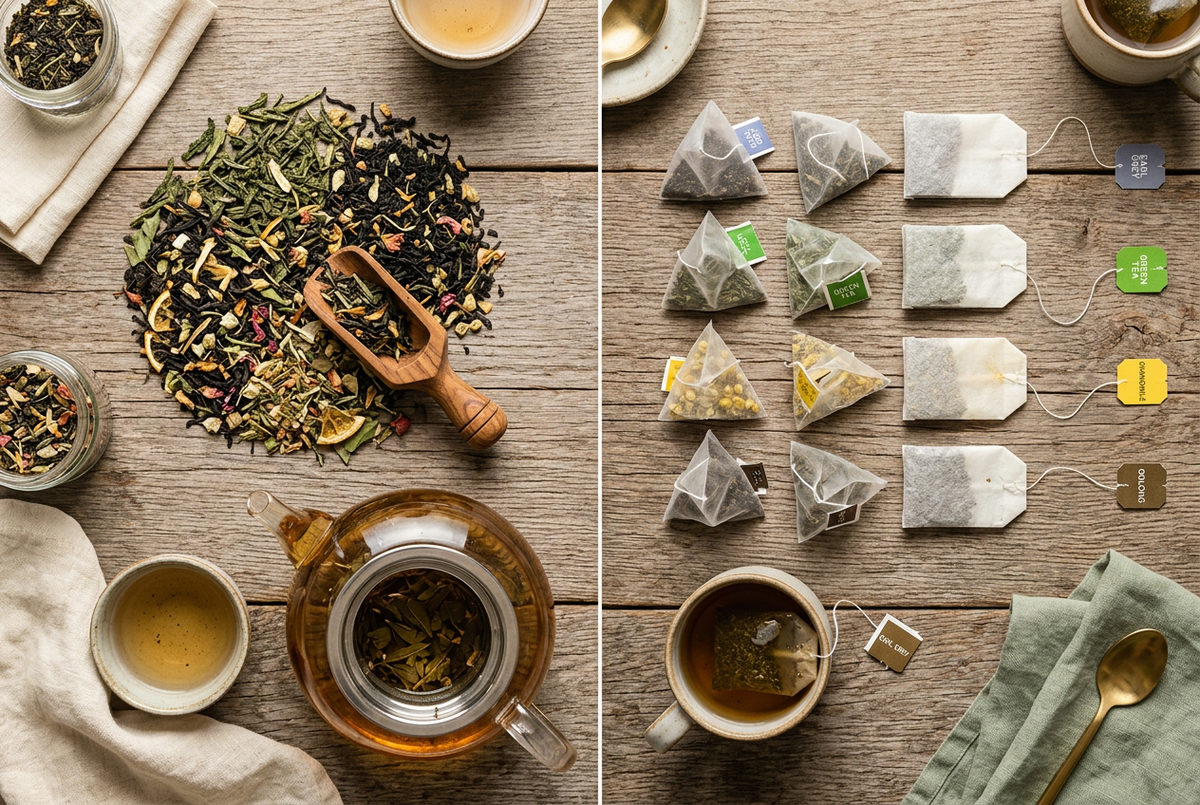
Does Loose Leaf Tea Taste Better Than Tea Bags?
Whole leaf gives you a fuller, more aromatic cup. Whole leaves keep more of their aromatic oils intact until the moment you brew, and they have room to unfurl. Most standard flat tea bags hold small broken particles called fannings and dust, which brew fast but lose aroma quickly. A roomy pyramid bag holding whole leaf comes close to loose leaf flavor. Full comparison in Loose Leaf Tea vs Tea Bags.
Why Loose Leaf Is Worth It for What You Drink Tea For
Whole leaf protects the active compounds you are brewing for. The calming apigenin in chamomile, [2] the linalool in lavender [3] and the menthol in peppermint are held inside intact flowers and leaves until hot water releases them. Brew whole leaf, cover the cup, and more of them end up in your tea instead of in the air.
It also keeps plastic out of your cup. In a study in Environmental Science & Technology, a single plastic tea bag steeped at 95°C released about 11.6 billion microplastic particles into one cup. [4] A stainless steel infuser and loose leaf skip that question entirely.
The Best Avodah Teas to Start With
New to loose leaf? Start with a blend that matches your day:
- For deep, restful sleep: Sleep Restore, chamomile and valerian root, caffeine-free.
- For a racing mind: Quiet Mind, lavender and rooibos, caffeine-free.
- For your afternoon lift: Velvet Earl Grey, whole-leaf Ceylon black tea with natural bergamot.
- For calm, steady energy: Lean Bloom, Ti Kuan Yin oolong and green tea.
A 50 g pouch makes about 25 cups, roughly 72¢ a cup, and less when you re-steep. Subscribe and save 20% so your favorite never runs out.
How to Make Loose Leaf Tea Taste Better
Change one thing at a time.
- Bitter? Use cooler water or a shorter steep, especially for green and white tea.
- Weak? Use a little more leaf, or steep slightly longer.
- Flat? Use fresh water and check how your tea is stored. Air, heat, light and moisture fade tea's aroma. See How to Store Tea.
- Unbalanced? Check the brewing instructions on your blend. A delicate green tea and a root-and-spice herbal blend need different handling.
The Avodah Moment: Loose Leaf Is a Ritual
Avodah means devotion and service. You give yours all day to the people and work you love. Loose leaf tea gives you a small, daily way to give some back to yourself.
Scoop. Pour. Wait. Lift. Sip.
It only takes a few minutes, but those minutes are a natural pause in a full day. Watch the leaves unfurl. Breathe in the steam. Wrap your hands around the warm cup before you take the first sip. Your tea does not need to be another thing to get perfect. It can simply be the part of the day when you make something for yourself.
You cannot pour from an empty cup. This is where you fill yours.
Frequently Asked Questions About Making Loose Leaf Tea
How much loose leaf tea should I use per cup?
One heaped teaspoon, about 2 to 3 grams, per 8 oz cup. Use a slightly bigger spoon for fluffy herbs and a level spoon for dense leaves.
How do you make tea with loose tea leaves?
Add the leaves to an infuser, pour water at the right temperature over them, steep for the recommended time, then remove the infuser before drinking.
Do you need an infuser for loose leaf tea?
No. You can brew the leaves loose in a cup or pot and pour through a strainer. An infuser simply makes it easier.
How do I make loose leaf tea without an infuser?
Add the leaves straight to your cup or pot, pour the water, steep, then pour through a small strainer, a paper filter, or a clean cloth.
Should loose leaf tea float?
Some leaves float at first and sink as they absorb water. Others keep floating. Both are normal.
Can you re-steep loose leaf tea?
Yes. Oolong, green, white, and whole-leaf black teas often give two or three infusions. Add about a minute each time.
Is loose leaf tea stronger than tea bags?
It is usually fuller and more aromatic, because whole leaves keep more of their oils and have room to unfurl. You also control exactly how much leaf goes in.
Can loose leaf tea be cold brewed?
Yes. Add the leaves to cold water, refrigerate overnight, then strain. Full method in our iced tea and cold brew guide.
Find Your Next Cup
Once you know how to brew loose leaf tea, choosing the tea becomes the fun part. Explore blends by the moment you want to create: calm, sleep, focus or comfort.
Explore Avodah Herbal Teas | Shop by Benefit | Explore Avodah Infuser Mugs
Your day. Your tea. Your Avodah Moment.
References
1. Astill C, Birch MR, Dacombe C, Humphrey PG, Martin PT. Factors affecting the caffeine and polyphenol contents of black and green tea infusions. J Agric Food Chem. 2001;49(11):5340-5347.
2. Viola H, Wasowski C, Levi de Stein M, et al. Apigenin, a component of Matricaria recutita flowers, is a central benzodiazepine receptors-ligand with anxiolytic effects. Planta Med. 1995;61(3):213-216.
3. Koulivand PH, Khaleghi Ghadiri M, Gorji A. Lavender and the nervous system. Evid Based Complement Alternat Med. 2013;2013:681304.
4. Hernandez LM, Xu EG, Larsson HCE, Tahara R, Maisuria VB, Tufenkji N. Plastic teabags release billions of microparticles and nanoparticles into tea. Environ Sci Technol. 2019;53(21):12300-12310.
These statements have not been evaluated by the Food and Drug Administration or Health Canada. Avodah teas are not intended to diagnose, treat, cure or prevent any disease. If you are pregnant, nursing, taking medication or managing a health condition, speak with your healthcare provider before adding a new herbal tea to your routine.


Leave a comment
This site is protected by hCaptcha and the hCaptcha Privacy Policy and Terms of Service apply.