Article: Loose Leaf Tea vs Tea Bags: Is Loose Leaf Better?
Loose Leaf Tea vs Tea Bags: Is Loose Leaf Better?
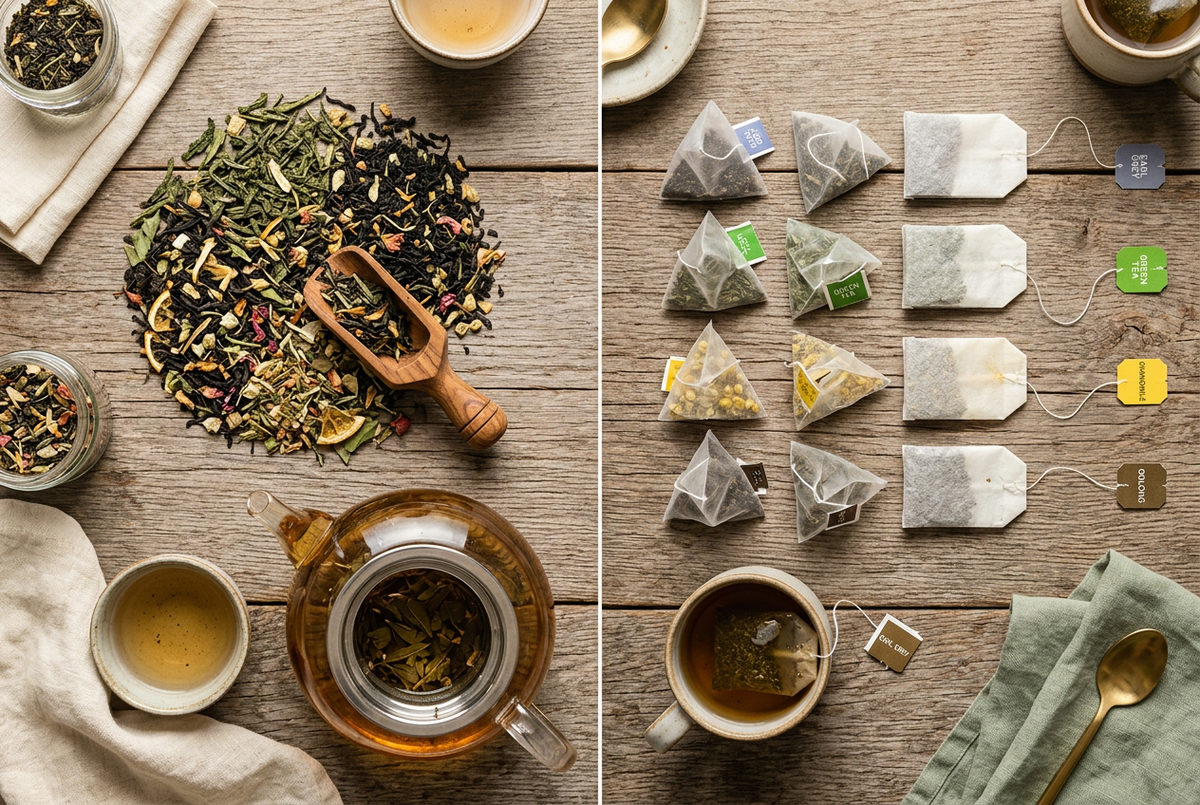
Loose leaf tea is better for flavor, freshness, and control. Whole leaves keep more of their aromatic oils, have room to unfurl, and can be re-steeped, while most standard bagged tea holds broken tea, the "dust and fannings," which brews fast but tastes flat. Tea bags win on convenience. The best of both is a roomy, plant-based pyramid bag holding whole leaf, which is what Avodah uses.
There is another reason the format matters. In a study published in Environmental Science & Technology, a single plastic tea bag steeped at 95°C released about 11.6 billion microplastic particles and 3.1 billion nanoplastic particles into one cup. [1] What your tea comes in can end up in your tea.
Here is how they compare, side by side.
Loose Leaf Tea vs Tea Bags at a Glance
|
Feature |
Loose leaf tea |
Standard tea bags |
Avodah pyramid bags |
|
Leaf quality |
Whole leaf |
Dust and fannings |
Whole leaf and botanicals |
|
Flavor and aroma |
Fullest |
Flatter |
Full |
|
Room to expand |
Excellent in a roomy infuser |
Cramped |
Excellent pyramid space |
|
Control over strength |
Total |
Pre-measured |
Pre-measured |
|
Re-steeping |
Yes, 2 to 3 times for many teas |
Rarely |
Depends on the blend |
|
Convenience |
A little more effort |
Easiest |
Easy |
|
Bag material |
No bag |
Often paper sealed with plastic, or nylon/PET mesh |
Plant-based, compostable PLA |
|
Best for |
Ritual, flavor, value |
Speed |
Everyday, no compromise |
What Is Loose Leaf Tea?
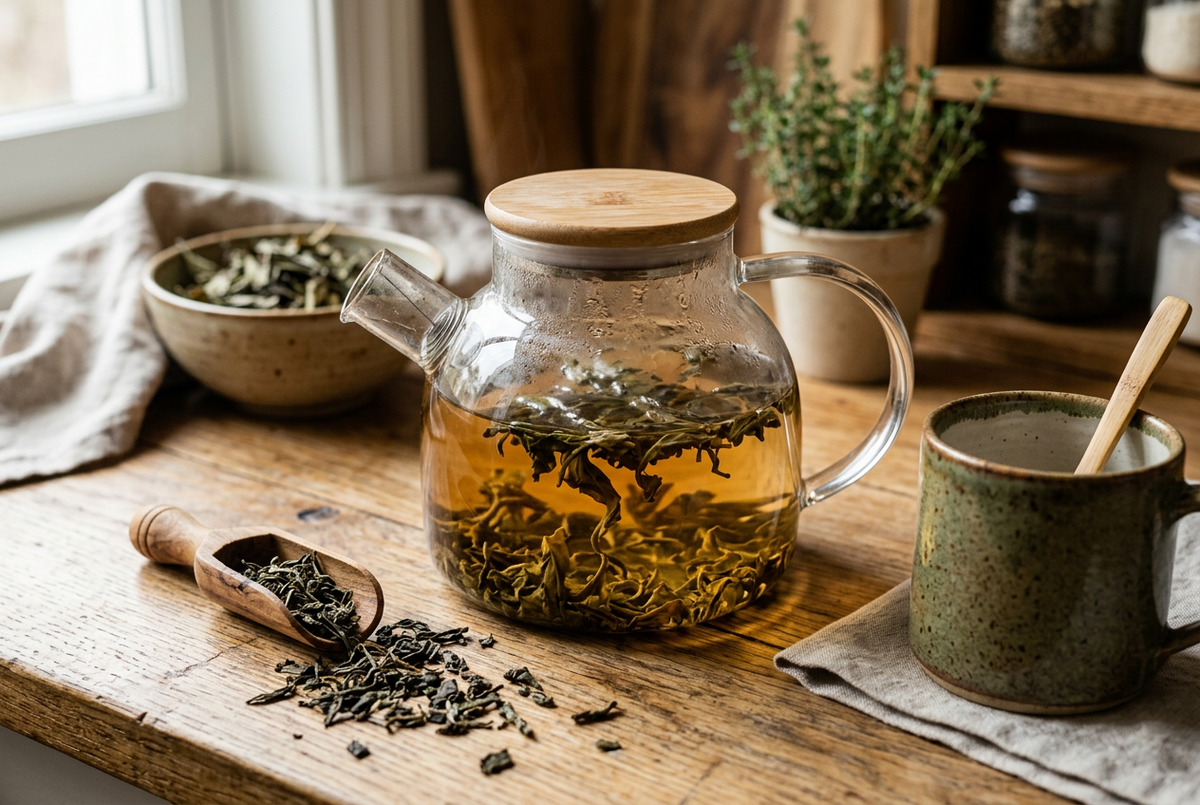
Loose-leaf tea is tea sold without an individual bag, usually as whole or large-cut leaves, flowers, roots, and fruit. You measure it yourself and brew it in a basket infuser, an infuser mug, or a teapot.
Because you control the amount, you control the strength: a little less leaf for a lighter cup, a little more for a fuller one. Loose leaf also suits blends with larger botanicals, such as chamomile flowers, rosehip, lavender buds, and valerian root, that need room to move. New to it? Start with How to Brew Loose Leaf Tea.
What Is Inside a Standard Tea Bag?
Most conventional tea bags are filled with the smallest grades of tea, known as fannings and dust. These are the tiny broken particles left over after processing whole leaves.
Their huge surface area means they brew fast, which is why bags are quick. It also means:
- They lose aroma faster. More exposed surface lets volatile aromatic oils escape during storage.
- They release tannins fast. Small particles over-extract quickly, making the cup harsh if left too long. Research confirms leaf size directly changes how fast caffeine and polyphenols move into your cup. [2]
- They have no room to move. A flat paper bag packs the particles tightly, so water cannot circulate the way it does around whole leaf.
Does Loose Leaf Tea Taste Better Than Tea Bags?
Brewed loose leaf gives you a fuller cup of tea with more complex flavor profiles, especially with black teas and oolongs, where whole leaves release layers of flavor that broken tea cannot.
Yes, whole leaf gives you a fuller, more aromatic, and more layered cup. Whole leaves keep their aromatic oils sealed inside until the moment you brew, then unfurl slowly, releasing flavor in stages rather than all at once. That is why loose leaf tastes rounder and why its second and third infusions reveal new notes.
Why Does Room to Expand Matter?
Tea leaves can expand to several times their dry size as they absorb water. Flowers soften, fruit rehydrates, roots and spices release flavor into the water around them. Pack those ingredients into a small flat bag, and the water cannot reach them all. A roomy infuser solves that for loose leaf. A tall pyramid bag does the same for pre-portioned tea.
Are Tea Bags Made of Plastic?
Many are. Some "silky" mesh tea bags are made from nylon or PET plastic, and many paper tea bags are heat-sealed with a thin plastic layer.
That matters because heat breaks plastic down. In the Environmental Science & Technology study, plastic tea bags steeped at 95°C released about 11.6 billion microplastics and 3.1 billion nanoplastics into a single cup. [1]
Avodah's pyramid bags are plant-based and compostable, made from PLA, a material derived from plants rather than petroleum. And our loose leaf comes with no bag at all.
What Is a Pyramid Tea Bag?
A pyramid tea bag is a tall, three-dimensional sachet that gives whole leaves and botanicals room to open. It holds ingredients a flat bag cannot: larger tea leaves, rooibos, flowers, fruit pieces, herbs and spices. You get close to loose-leaf flavor with tea bag convenience.
That is why Avodah uses pyramid bags for blends like Sleep Restore Tea and Velvet Earl Grey: the same whole leaves either way, just packed for busy mornings.
Is Loose Leaf Tea Healthier Than Tea Bags?
Whole leaf delivers more of what you are drinking tea for. Intact leaves hold their aromatic oils and plant compounds until you brew, while broken dust has already lost much of its aroma to the air. With whole leaf you also control how much goes in, so you can brew a fuller cup. And loose leaf skips the plastic question entirely. [1]
What matters most is the plant itself and its freshness: high-quality whole leaf, stored well, brewed properly. Loose leaf makes all three easy to see and control.
Which Is Fresher, Loose Leaf Tea or Tea Bags?
Whole leaf stays fresh longer. Its smaller exposed surface means less aroma escapes over time. Either way, storage is everything: keep tea sealed, dry, cool, and away from light. See How to Store Tea (and Does Tea Expire?).
Is Loose Leaf Tea Stronger Than Tea Bags?
Loose leaf gives you a fuller cup and total control over strength. Fine tea bag particles can taste "strong" because they extract fast, but that strength is mostly tannin bite rather than depth of flavor. With loose leaf, you set the amount of leaf, the temperature, and the time. See our steep time chart.
Can You Re-Steep Loose Leaf Tea?
Yes, and it is one of loose leaf's biggest advantages. Oolong, green, white, and whole-leaf black teas often give two or three excellent infusions, each one different from the last. Add about a minute to each steep. Standard tea bags are usually spent after one cup.
Is Loose Leaf Tea More Expensive?
Loose leaf usually costs less per cup. It looks pricier on the shelf because you buy it by weight. But a 50 g pouch of Avodah loose leaf makes about 25 cups, roughly 72¢ a cup, and many teas re-steep two or three times, bringing the real cost per cup down further. Compare servings, not package prices.
Are Tea Bags Easier Than Loose Leaf Tea?
Yes, convenience is their biggest advantage. Drop one in a mug, add water, steep, remove. Loose leaf takes one extra step: measuring the leaves and emptying the infuser. An infuser mug makes that step almost effortless.
Is Loose Leaf Tea Harder to Make?
Not once you have an infuser.
- Add tea to the infuser.
- Pour in hot water.
- Steep.
- Remove the infuser.
- Drink.
The only part that takes learning is the right amount, temperature, and time, and we have Tea 101 guides for exactly that: how to make loose leaf tea, the steep time chart, and how to use a tea infuser.
How to Tell if Your Tea Bags Contain Plastic
Check three things before you buy:
1. The material. "Silky," or "nylon" bags are usually plastic. Look for plant-based materials stated clearly on the pack.
2. The seal. Many paper bags are heat-sealed with a thin plastic layer. Brands that avoid it usually say so.
3. The brand's answer. If the packaging does not say, ask. A tea company that cares about what goes in your cup will tell you.
Or skip the question entirely and brew loose-leaf in a stainless-steel infuser.
Plastic-Free Tea Bags: What Actually Qualifies
A truly plastic-free tea bag is unbleached or plain paper with no heat-sealed plastic layer, closed by folding, cotton string, or a plant-based adhesive. Watch the wording on the box:
- "Plastic-free" should mean no plastic of any kind, including the seal.
- "Plant-based" or "PLA" means a bioplastic made from corn or sugarcane. It is compostable in industrial facilities, but it is still a polymer, so it is not the same as plastic-free.
- "Silky," or "nylon" means plastic.
The only 100% plastic-free option every time is loose leaf in a stainless steel infuser. That is why we sell our blends loose, and why our pyramid bags are plant-based PLA rather than petroleum plastic. To compost either, see Can You Compost Tea Bags?
Which Is Better for the Planet?
Loose leaf creates the least waste. There is no bag, no tag, no staple, and no individual wrapper, just the leaves and a resealable pouch. Spent leaves go straight into the compost or the garden, where they add organic matter to the soil. If you prefer bags, choose compostable, plant-based ones and check whether they need a home or an industrial compost.
How to Switch From Tea Bags to Loose Leaf in 3 Steps
- Get a roomy infuser. A basket infuser or an infuser mug makes loose leaf as easy as a bag.
- Start with one heaped teaspoon per cup. Adjust up or down after your first few cups.
- Keep a timer handy. Loose leaf rewards the right steep time. Our steep time chart covers every tea.
Within a week, it becomes second nature, and your old tea bags will taste flat by comparison.
What Is the Best Option for Beginners?
Start with whole-leaf pyramid bags for ease, then try loose leaf with a roomy infuser when you want the full ritual. Many people use both: pyramid bags for rushed mornings, loose leaf for quiet evenings at home.
The Avodah Moment: Ritual or Rush, You Still Deserve a Good Cup
Avodah means devotion and service. Some days the ritual of loose leaf is the whole point: scoop, steep, watch the leaves unfurl, take your time. Other days you have ninety seconds before the next thing.
Both kinds of day deserve a good cup. On the slow days, let loose leaf be your pause: breathe while it steeps, hold the warm mug, sip slowly. On the busy days, drop in a whole-leaf pyramid bag and still give yourself one minute of quiet before you go.
You cannot pour from an empty cup. Whatever the day, this is where you fill yours.
Frequently Asked Questions About Loose Leaf Tea vs Tea Bags
Is loose leaf tea better than tea bags?
Yes, for flavor, freshness, and control. Whole leaves keep more aroma, have room to unfurl and can be re-steeped. Tea bags win on convenience.
Are tea bags made of plastic?
Many are. Some mesh bags are nylon or PET, and many paper bags are sealed with plastic. A study found plastic tea bags released about 11.6 billion microplastics into one cup.
Is loose leaf tea healthier than tea bags?
Whole leaf keeps more of its aromatic oils and plant compounds until you brew; you control how much goes in, and it avoids plastic bags entirely.
Are pyramid tea bags better than regular tea bags?
Yes. They give whole leaves and botanicals room to open, getting close to loose leaf flavour with tea bag convenience.
Is loose leaf tea cheaper than tea bags?
Usually, per cup. A 50 g pouch makes about 25 cups, and many loose leaf teas re-steep two or three times.
Do tea bags contain lower quality tea?
Standard flat tea bags usually contain fannings and dust, the smallest broken grades. Whole-leaf pyramid bags are the exception.
Can you steep tea bags twice?
Standard bags are usually spent after one cup. Whole-leaf pyramid bags often give a lighter second cup.
Which should a beginner choose?
Start with whole-leaf pyramid bags for ease, then try loose leaf with an infuser when you want the full ritual.
So, Loose Leaf or Tea Bag?
Choose loose leaf when you want the fullest flavor, total control, multiple infusions, and the ritual.
Choose a whole-leaf pyramid bag when you want speed, easy clean-up, and something to take with you.
Skip plastic in both.
Explore Avodah Teas | Explore Avodah Infuser Mugs | Explore More Tea 101 Guides
Your day. Your tea. Your Avodah Moment.
References
1. Hernandez LM, Xu EG, Larsson HCE, Tahara R, Maisuria VB, Tufenkji N. Plastic teabags release billions of microparticles and nanoparticles into tea. Environ Sci Technol. 2019;53(21):12300-12310.
2. Astill C, Birch MR, Dacombe C, Humphrey PG, Martin PT. Factors affecting the caffeine and polyphenol contents of black and green tea infusions. J Agric Food Chem. 2001;49(11):5340-5347.
*These statements have not been evaluated by the Food and Drug Administration or Health Canada. Avodah teas are not intended to diagnose, treat, cure or prevent any disease. If you are pregnant, nursing, taking medication or managing a health condition, speak with your healthcare provider before adding a new herbal tea to your routine.


Leave a comment
This site is protected by hCaptcha and the hCaptcha Privacy Policy and Terms of Service apply.