
How to Get Rid of Caffeine Jitters Fast
To get rid of caffeine jitters fast: stop all caffeine, drink a big glass of water, eat something high in protein and fiber, take a brisk 10-minute walk, breathe slowly with long exhales, and make your next cup a calming, caffeine-free tea like lavender or rooibos. These steps will not remove caffeine from your body instantly, but they calm the racing heart, shaky hands, and anxious edge while your body clears it.
Then comes the real fix: changing how you get your energy so the jitters do not come back. Here is why caffeine makes you jittery, how long it lasts, and the tea swaps that give you energy without the edge.
Why Caffeine Gives You the Jitters
Caffeine blocks adenosine, your brain's "slow down" signal, and pushes your body into a mild stress response. With adenosine blocked, your nervous system revs up: adrenaline rises, your heart beats faster, and your muscles tense.
Caffeine also raises cortisol, your main stress hormone. In a controlled study, caffeine increased cortisol across the day, even in regular coffee drinkers. [1] Too much at once and the result is the jitters: shaky hands, a racing heart, restlessness, a nervous stomach, and an anxious, wired mind.
Will Caffeine Cause Anxiety?
Yes, caffeine can trigger or worsen anxiety, especially in sensitive people. A systematic review and meta analysis found caffeine significantly increased anxiety, and in people with panic disorder it could trigger panic attacks. [2] Too much caffeine can even cause "caffeine-induced anxiety disorder," a recognized diagnosis.
How much is too much varies, but Health Canada and the U.S. Food and Drug Administration both suggest most healthy adults stay at or below 400 mg a day, roughly four cups of brewed coffee. [3] [4] Many people feel jittery well below that, depending on body size, genetics, sleep and whether they ate.
Signs You Have Had Too Much Caffeine
• Shaky hands or trembling
• A racing or pounding heart
• Restlessness, can't sit still
• Feeling anxious, nervous, or on edge
• A nervous or upset stomach
• Headache
• Trouble falling asleep later
If you have chest pain, a very irregular heartbeat, trouble breathing, or confusion, seek medical help right away.
How to Get Rid of Caffeine Jitters: 7 Steps
1. Stop the Caffeine
No more coffee, energy drinks, black or green tea, or chocolate for now. Every extra milligram extends the jitters.
2. Drink Water
Drink a big glass of water, then keep sipping. Caffeine is mildly dehydrating, and dehydration makes a racing heart and shakiness feel worse.
3. Eat Something
Caffeine on an empty stomach hits harder and faster. Eat something with protein, fiber, and healthy fat, like Greek yogurt, eggs, nuts, or toast with nut butter, to steady your blood sugar and ease the edge.
4. Move Your Body
Take a brisk 10 to 15 minute walk. Movement burns off the adrenaline rush and releases the physical tension caffeine creates.
5. Breathe Slowly
Breathe in for 4 counts and out for 6, for 5 minutes. Long exhales activate your vagus nerve and your "rest and digest" nervous system, slowing your heart rate and calming the stress response.*
6. Sip a Caffeine-Free Calming Tea
A warm, caffeine-free herbal tea calms you two ways: the herbs and the ritual.*
- Lavender: its linalool acts on the nervous system to promote calm.* [5] In a clinical trial, lavender tea reduced anxiety scores.* [6]
- Chamomile: its apigenin binds to calming GABA-A receptors in the brain.* [7]
- Rooibos: naturally caffeine-free, and its compounds reduced cortisol production in laboratory research.* [8]
Quiet Mind Tea combines lavender and rooibos with rose and berries for exactly this moment. Brew it, cover it, and breathe while it steeps. Steps 5 and 6 work beautifully together.
7. Wait It Out Kindly
Caffeine's effects fade over several hours. The average half-life of caffeine is about 5 hours, meaning half of it is still in your system 5 hours later. [9] The worst of the jitters usually eases within an hour or two, especially with the steps above.
How Long Do Caffeine Jitters Last?
Most caffeine jitters peak within 30 to 60 minutes and ease over the next few hours. Because caffeine's half-life averages around 5 hours (ranging from about 3 to 7 hours depending on the person), [9] an afternoon coffee can still be affecting your sleep at bedtime.
How to Stop Caffeine Jitters From Coming Back
Swap Coffee for Matcha
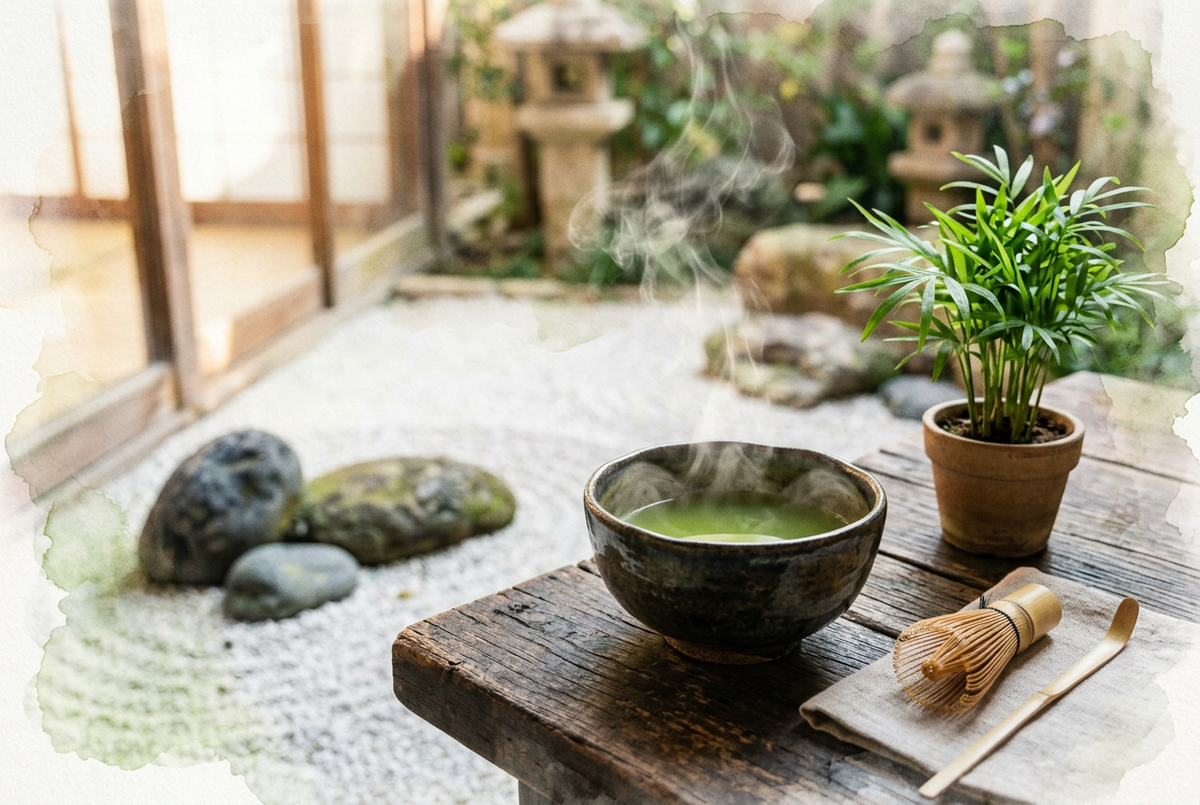
Matcha gives you calm energy instead of jittery energy.* It contains L-theanine, an amino acid that promotes relaxed alertness by increasing alpha brain waves.* [10] In a randomized trial, L-theanine paired with caffeine improved focus and reduced distraction.* [11] A typical serving of matcha also contains less caffeine than a mug of coffee. Try our ceremonial grade Green Zen Tea. Read more in Green Tea to Relax.
Set a Caffeine Cut-Off
Have your last caffeine by early afternoon, around 2 pm, to protect your evening and your sleep.
Make Your Afternoon Cup Caffeine-Free
Swap the 3 pm coffee for rooibos. It tastes rich like black tea with zero caffeine. See Does Rooibos Tea Have Caffeine? Our Serene Tranquility Tea is a warm, spiced rooibos made for the afternoon slump.
Never Caffeinate on an Empty Stomach
Always pair coffee or tea with food.
Build a Caffeine-Smart Day
The Midday Reset bundle is built for exactly this: Lean Bloom oolong for calm morning focus, Belly Balance after lunch, and caffeine-free Quiet Mind for the afternoon. Explore every caffeine-free option in our tea for stress relief guide.
The Avodah Moment: Come Back Down
Avodah means devotion and service. Many of us reach for caffeine to keep up with everything everyone needs. Then the jitters arrive, and the very fuel that was supposed to help leaves us frazzled.
When it happens, stop. Put the kettle on for a caffeine-free cup. While it steeps, stand by a window and breathe: in for four, out for six. Sip slowly. Feel your heartbeat come back to its normal rhythm. You do not have to run on adrenaline to serve well. Calm is a far better fuel.
You cannot pour from an empty cup. This is where you fill yours.
Shop Quiet Mind Tea | Shop Green Zen Tea
Frequently Asked Questions
How do you get rid of caffeine jitters fast?
Stop caffeine, drink water, eat something with protein, take a brisk walk, breathe slowly with long exhales, and sip a caffeine-free calming tea like lavender or rooibos.
Will caffeine cause anxiety?
It can. A meta-analysis found caffeine significantly increased anxiety, especially in sensitive people and those with panic disorder.
How long do caffeine jitters last?
They usually peak within 30 to 60 minutes and ease over the next few hours. Caffeine's half-life averages about 5 hours.
What drink stops caffeine jitters?
Water first, then a warm caffeine-free calming tea. Lavender's linalool and chamomile's apigenin calm the nervous system.*
Does eating help caffeine jitters?
Yes. Food with protein and fiber slows caffeine's effect and steadies blood sugar.
How much caffeine is too much?
Health Canada and the FDA suggest most healthy adults stay at or below 400 mg a day. Many people feel jittery at less.
What is a good coffee alternative without jitters?
Matcha, for calm energy thanks to L-theanine, or caffeine-free rooibos for the afternoon.*
References
1. Lovallo WR, Whitsett TL, al'Absi M, Sung BH, Vincent AS, Wilson MF. Caffeine stimulation of cortisol secretion across the waking hours in relation to caffeine intake levels. Psychosom Med. 2005;67(5):734-739.
2. Klevebrant L, Frick A. Effects of caffeine on anxiety and panic attacks in patients with panic disorder: a systematic review and meta-analysis. Gen Hosp Psychiatry. 2022;74:22-31.
3. Health Canada. Caffeine in Food. Government of Canada.
4. U.S. Food and Drug Administration. Spilling the Beans: How Much Caffeine Is Too Much? Consumer Update.
5. Koulivand PH, Khaleghi Ghadiri M, Gorji A. Lavender and the nervous system. Evid Based Complement Alternat Med. 2013;2013:681304.
6. Bazrafshan MR, Jokar M, Shokrpour N, Delam H. The effect of lavender herbal tea on the anxiety and depression of the elderly: a randomized clinical trial. Complement Ther Med. 2020;50:102393.
7. Viola H, Wasowski C, Levi de Stein M, et al. Apigenin, a component of Matricaria recutita flowers, is a central benzodiazepine receptors-ligand with anxiolytic effects. Planta Med. 1995;61(3):213-216.
8. Schloms L, Storbeck KH, Swart P, Gelderblom WC, Swart AC. The influence of Aspalathus linearis (Rooibos) and dihydrochalcones on adrenal steroidogenesis: quantification of steroid intermediates and end products in H295R cells. J Steroid Biochem Mol Biol. 2012;128(3-5):128-138.
9. Institute of Medicine (US) Committee on Military Nutrition Research. Caffeine for the Sustainment of Mental Task Performance: Formulations for Military Operations. Washington (DC): National Academies Press; 2001.
10. Juneja LR, Chu DC, Okubo T, Nagato Y, Yokogoshi H. L-theanine: a unique amino acid of green tea and its relaxation effect in humans. Trends Food Sci Technol. 1999;10(6-7):199-204.
11. Owen GN, Parnell H, De Bruin EA, Rycroft JA. The combined effects of L-theanine and caffeine on cognitive performance and mood. Nutr Neurosci. 2008;11(4):193-198.



Leave a comment
This site is protected by hCaptcha and the hCaptcha Privacy Policy and Terms of Service apply.