

Best Tea for Sleep: The Teas That Actually Help You Sleep
The best tea for sleep is a caffeine-free herbal blend built on valerian root and chamomile, the two most studied herbs for rest, sipped about 45 minutes before bed.* Valerian's valerenic acid amplifies GABA, your brain's natural "slow down" signal, and chamomile's apigenin binds to the calming receptors that help you drift off and stay asleep through the night.* [1] [2] [3]
A good sleep tea works on two levels at once. The herbs deliver active plant compounds that calm your nervous system, and the warm, repeated ritual tells your body the day is done. This guide covers all of it: which herbs have the science, how they work, which tea to reach for depending on why you are awake, how to brew it, and how to turn it into the most powerful five minutes of your evening. Every claim is numbered to its research so you can check it yourself.
Does Tea Actually Help You Sleep?
Yes. Clinical research links several sleep herbs to better sleep quality, falling asleep faster and fewer night wakings.*
- Chamomile: a 2024 meta analysis of 10 clinical trials (772 participants) found chamomile improved sleep, especially helping people stay asleep and wake less during the night.* [3]
- Valerian: a review of around 60 studies concluded valerian improves sleep quality and eases anxiety, [4] and in a classic clinical trial a water extract of valerian, the same kind you make when you brew tea, improved sleep quality and helped people fall asleep faster, with the biggest gains in poor sleepers.* [5]
- Passionflower: in a randomized trial, a week of passionflower tea improved sleep quality compared with placebo tea.* [6]
These herbs work best the way tea is meant to be enjoyed: every night, as part of a consistent wind-down.
How Sleep Teas Actually Work
Most sleep herbs work on one calming system in your brain: GABA. GABA (gamma-aminobutyric acid) is your nervous system's brake pedal. When GABA activity rises, mental chatter and physical tension fall, and sleep comes more easily.*
- Chamomile works through apigenin, a flavonoid that binds to the benzodiazepine sites on GABA-A receptors, the same receptors targeted by prescription calming medicines, producing a gentle, natural settling effect.* [2] [7]
- Valerian root works through valerenic acid, which binds directly to GABA-A receptors to calm the nervous system, supported by its valepotriates and natural GABA content.* [1]
- Lavender works through linalool and linalyl acetate, aromatic compounds that calm the nervous system whether you breathe them in or sip them.* [8]
The best sleep herbs do not force you unconscious. They turn up a calming system your brain already uses to fall asleep, so you ease into rest and wake up clear.*
The Best Teas for Sleep, and Which Herbs Earn Their Place
The best sleep teas pair one or two proven active herbs with supporting botanicals that make the cup a pleasure.
The Two Heavy Hitters
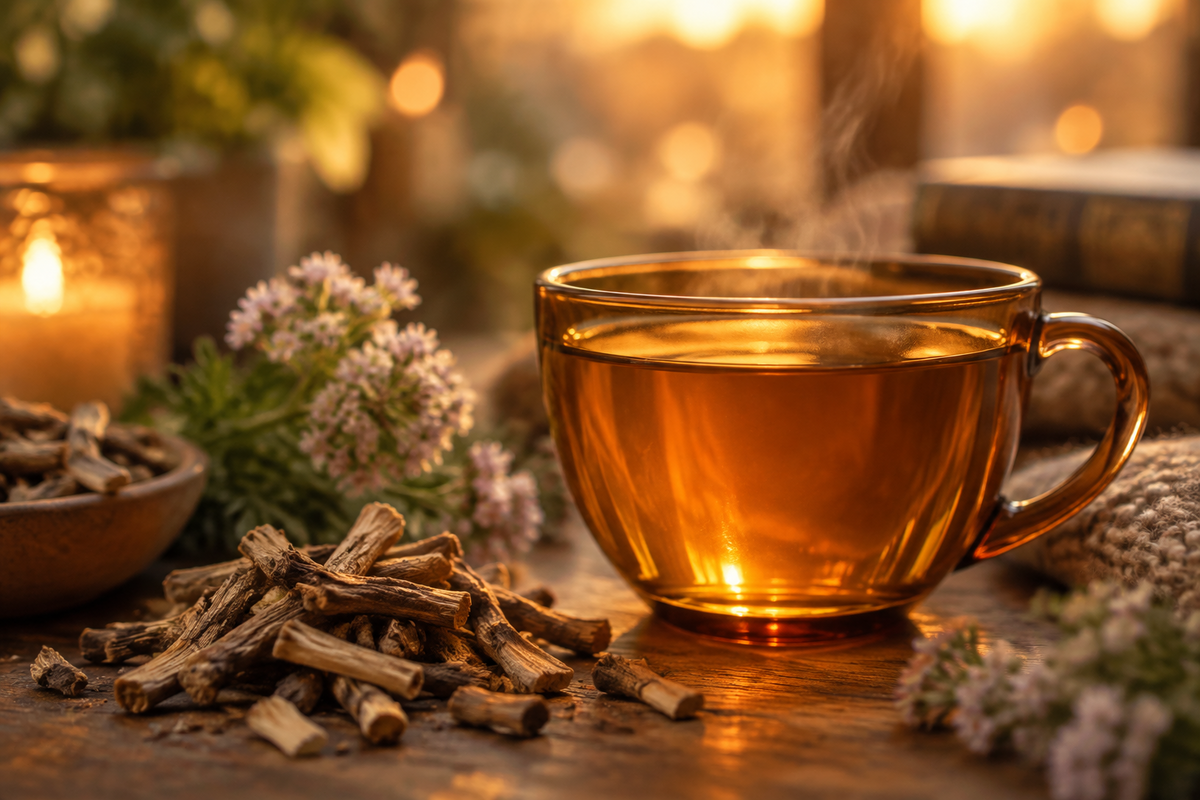
Valerian root: The most powerful herbal sleep ingredient. Earthy and assertive, it is the herb to reach for when you want serious support falling asleep and staying there.* [1] [5] Read the full story in Valerian Root Tea for Sleep.
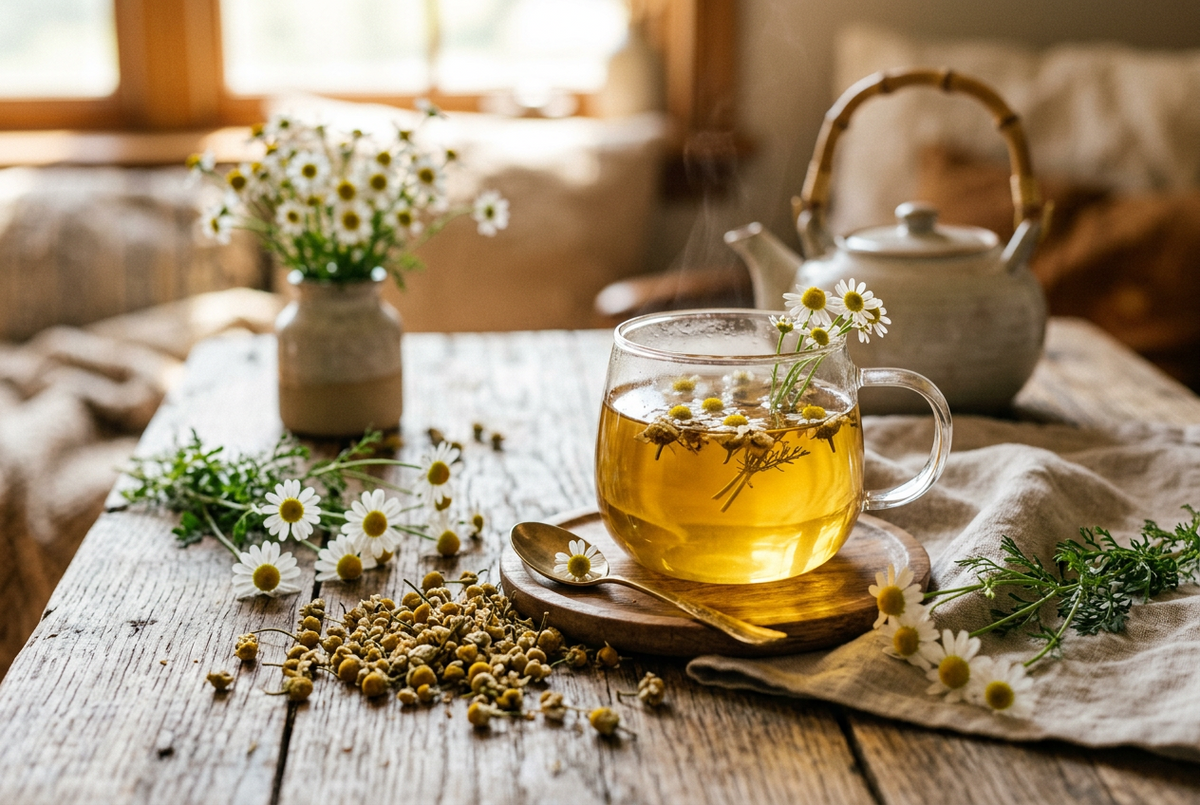
Chamomile: The most studied sleep herb in the world. Its apigenin settles a busy mind, and clinical trials link it to better sleep quality and easing generalized anxiety, which matters because an anxious mind is often what keeps you awake.* [3] [9] See Does Chamomile Tea Help You Sleep?
The Calming Supporters
Lavender: Its linalool calms racing thoughts, and in clinical studies lavender tea eased anxiety in older adults and fatigue in sleep-disturbed new mothers.* [10] [11] Lavender leads our Quiet Mind Tea.
Lemon balm and passionflower: Two traditional calming herbs with clinical support: lemon balm eased anxiety and sleep problems in people under stress, and passionflower tea improved sleep quality.* [12] [6]
The Supporting Cast
In our Sleep Restore Tea, chamomile and valerian do the heavy lifting, surrounded by herbs that make every cup a pleasure:
- Lemongrass: a bright citrus note rich in citral, traditionally used to relax at the end of the day.*
- Peppermint and spearmint: menthol relaxes the digestive tract so a heavy evening does not get in the way of rest.*
- Rosehip: a soft, vitamin C rich tartness.*
- Hibiscus: ruby colour and anthocyanin antioxidants.*
- Blue cornflower: petals that make the cup as lovely to look at as it is to drink.
The formula is simple: pair the two most studied sleep herbs so they do the real work, and make the cup delicious enough that you reach for it every single night.
Which Sleep Tea Should You Drink for Your Problem?
"Can't sleep" is really three different problems, and each has its best tea.
If your mind races and you can't fall asleep, reach for the calming herbs: chamomile and lavender. Their compounds quiet the anxious, overactive thinking that keeps you staring at the ceiling.* Quiet Mind Tea and Sleep Restore Tea are both built for this. More in Best Tea for Sleep and Anxiety.
If you fall asleep fine but wake in the night, reach for valerian, ideally paired with chamomile, which the 2024 meta analysis found especially helpful for staying asleep.* [3] This is exactly what Sleep Restore Tea was designed for. More in Why Can't I Stay Asleep?
If you want your whole evening to wind down, build a caffeine-free ritual that moves you from wired to rested. The Evening Unwind bundle pairs Sleep Restore with Quiet Mind and Serene Tranquility, so you have the right cup for every kind of night.
What Is the Best Tea to Drink Before Bed?
The best bedtime tea is caffeine-free and built on chamomile and valerian root, drunk 30 to 60 minutes before bed. If sleeplessness comes from a racing mind, add lavender; see Does Lavender Help You Sleep?. If you love green tea, keep it to the morning: here is why in Green Tea Before Bed: Is It a Good Idea?
Is Sleep Tea Caffeine-Free?
True herbal sleep teas are 100% caffeine-free, but always read the label. Chamomile, valerian, lavender and rooibos contain no caffeine at all. The trap is "bedtime" blends that add green or black tea, which do contain caffeine.
The rule: if the label lists green tea, black tea, white tea, oolong or just "tea," it has caffeine. If it lists only herbs, flowers and roots, it is caffeine-free. Sleep Restore is completely caffeine-free, so a second cup is never a problem. See The Best Caffeine Free Teas for Sleep and Does Chamomile Tea Have Caffeine?
When Should You Drink Sleep Tea, and How Much?
Drink one cup about 45 minutes before bed. That gives the herbs time to work while you wind down, and finishing your cup half an hour before you lie down means you will not wake up needing the bathroom.
Then make it a nightly habit. Valerian's sleep benefits build over two to four weeks of regular use, and your body learns to associate the ritual with sleep.* [13] One 24-bag pouch of Sleep Restore covers more than three weeks of nightly cups, exactly the window it needs to show its best.
How to Brew a Sleep Tea Properly
1. Pour water just off the boil over one tea bag or one teaspoon of loose blend.
2. Cover your cup. Many calming compounds in chamomile and lavender live in their volatile oils, the part you can smell. A saucer on top keeps them in your tea instead of drifting away in the steam.
3. Steep for the full 5 to 7 minutes. Herbs release their compounds more slowly than black tea bags do, so a rushed steep leaves the good stuff behind.
4. Sip slowly, somewhere comfortable, with the lights low.
For a step by step chamomile method, see How to Make Chamomile Tea.
How Long Does Sleep Tea Take to Work?
Most people feel calmer within 30 to 60 minutes of their first cup, and the full sleep benefit builds over two to four weeks of nightly use.* [13]
Tonight: the warmth, the aroma and chamomile's apigenin begin calming your nervous system within the hour.* [2]
Week one: your body starts to recognize the ritual. The same cup at the same time becomes a cue that sleep is coming.
Weeks two to four: valerian's benefits build with consistent use. In a sleep lab study, two weeks of valerian increased deep, slow-wave sleep.* [14]
That is why consistency beats strength. A good tea every night outperforms a strong tea now and then.
Five Sleep Tea Mistakes to Avoid
- Choosing a "sleep" blend with hidden tea leaves: Green or black tea means caffeine. Read the label.
- Leaving the cup uncovered: The calming aromatic oils escape in the steam.
- Rushing the steep: Two minutes leaves most of the active compounds in the bag. Give it 5 to 7.
- Drinking it in bed: A big mug right before lights out means a 3 am bathroom trip. Finish 30 minutes before bed.
- Giving up after one night: Valerian builds over two to four weeks. Judge it after a full pouch, not a single cup.*
Explore the Sleep Library
Every question about tea and sleep, answered in depth:
- The herbs: Valerian Root Tea for Sleep | Chamomile Tea Benefits | Chamomile vs Valerian
- Your sleep problem: Why Can't I Stay Asleep? | How to Get More Deep Sleep | Best Tea for Sleep and Anxiety | Natural Remedies for Insomnia
- Your routine: The Evening Wind-Down Routine | How to Make Chamomile Tea | Melatonin vs Herbal Tea
- Safety: Is Sleep Tea Safe Every Night? | Is Chamomile Tea Safe? | Valerian Side Effects
- Our blend: Meet Sleep Restore Tea
Is Sleep Tea Safe? Pregnancy, Medication, and Drinking It Nightly
For most healthy adults, a herbal sleep tea is safe to enjoy every night. It is a food, not a drug, and it is not habit forming. In valerian research, side effects were no more common than with placebo. [13]
Check with your healthcare provider first if you are pregnant or breastfeeding, take sedatives, sleep or anxiety medication or blood thinners, or manage a health condition. Hibiscus is best moderated if you have low blood pressure. Read more in Is It Safe to Drink Sleep Tea Every Night? and Is Chamomile Tea Safe?
The Avodah Moment: Make It a Ritual, Not Just a Drink
Avodah means devotion and service. You spend your days pouring that devotion into your work, your family and everyone who needs you. The Avodah Moment is that devotion turned back toward yourself.
Put the kettle on. Let the lights go soft. Drop a bag of Sleep Restore into your favourite mug, cover it, and breathe slowly while it steeps: in for four, out for six. Then sit with it. Wrap both hands around the warm cup and let these five minutes belong to you, at the end of a day you gave to everyone else.
You cannot pour from an empty cup. Every night, this is where you fill yours. Pair it with our evening wind down routine for the full ritual.
So, What Is the Best Tea for Sleep?
The best tea for sleep is a caffeine-free blend built on valerian root and chamomile, made from whole botanicals, with nothing hidden and the research named. That is exactly how we built Sleep Restore Tea: valerian and chamomile doing the heavy lifting, a supporting cast of herbs making it a cup you will finish, naturally sweetened with organic stevia leaf, and every ingredient linked to its study.
Want the whole evening covered? The Evening Unwind bundle pairs Sleep Restore with Quiet Mind and Serene Tranquility: three caffeine-free teas to move you from wired to rested.
Real herbs. Real research. Real rest.
Shop Sleep Restore Tea | Shop the Evening Unwind Bundle
Frequently Asked Questions
What is the best tea for sleep?
A caffeine-free blend of valerian root and chamomile. Valerian amplifies the brain's calming GABA signal and chamomile's apigenin promotes relaxation, so together they help you fall asleep faster and stay asleep.*
Does chamomile tea have caffeine?
No. Chamomile is made from flowers, not tea leaves, so it is naturally caffeine-free and perfect right before bed.
Does chamomile tea actually help you sleep?
Yes. A 2024 meta analysis of 10 clinical trials found chamomile improved sleep, especially helping people stay asleep through the night.*
When should I drink sleep tea?
About 45 minutes before bed, finishing your cup half an hour before you lie down. One cup is plenty.
Can I drink sleep tea every night?
Yes. For most healthy adults, herbal sleep tea is safe nightly and not habit forming. Check with your doctor if you are pregnant, nursing or on medication.
Chamomile or valerian: which is better for sleep?
Chamomile is best for an anxious, racing mind; valerian is stronger and best for deep, uninterrupted sleep. Sleep Restore uses both so they work together.*
How long does sleep tea take to work?
Most people feel calmer within the hour, and the full benefit builds over two to four weeks of nightly use.*
What herbal teas are best for sleep and relaxation?
Valerian root, chamomile, lavender, lemon balm, and passionflower. Valerian and chamomile have the most research for sleep; lavender is best for a racing mind.*
What tea should I drink to help me sleep?
A caffeine-free tea with chamomile and valerian root, such as Sleep Restore, 30 to 60 minutes before bed. Add lavender if a racing mind keeps you awake.
What is a good bedtime tea?
Any caffeine-free calming tea: chamomile, valerian, lavender, rooibos or peppermint. Avoid green, black and other caffeinated teas after mid-afternoon.
Is herbal tea better than melatonin?
For everyday, nightly use, yes. Melatonin shifts your body clock; herbal tea calms your nervous system without hormones and builds a soothing ritual.* See Melatonin vs Herbal Tea for Sleep.
References
1. Benke D, Barberis A, Kopp S, et al. GABA A receptors as in vivo substrate for the anxiolytic action of valerenic acid, a major constituent of valerian root extracts. Neuropharmacology. 2009;56(1):174-181. https://pubmed.ncbi.nlm.nih.gov/18602406/
2. Srivastava JK, Shankar E, Gupta S. Chamomile: a herbal medicine of the past with bright future. Mol Med Rep. 2010;3(6):895-901. https://pmc.ncbi.nlm.nih.gov/articles/PMC2995283/
3. Kazemi A, Shojaei-Zarghani S, Eskandarzadeh P, Hashempur MH. Effects of chamomile (Matricaria chamomilla L.) on sleep: a systematic review and meta-analysis of clinical trials. Complement Ther Med. 2024;84:103071. https://www.sciencedirect.com/science/article/pii/S0965229924000591
4. Shinjyo N, Waddell G, Green J. Valerian root in treating sleep problems and associated disorders: a systematic review and meta-analysis. J Evid Based Integr Med. 2020;25:2515690X20967323. https://journals.sagepub.com/doi/10.1177/2515690X20967323
5. Leathwood PD, Chauffard F, Heck E, Munoz-Box R. Aqueous extract of valerian root (Valeriana officinalis L.) improves sleep quality in man. Pharmacol Biochem Behav. 1982;17(1):65-71. https://pubmed.ncbi.nlm.nih.gov/7122669/
6. Ngan A, Conduit R. A double-blind, placebo-controlled investigation of the effects of Passiflora incarnata (passionflower) herbal tea on subjective sleep quality. Phytother Res. 2011;25(8):1153-1159.
7. Viola H, Wasowski C, Levi de Stein M, et al. Apigenin, a component of Matricaria recutita flowers, is a central benzodiazepine receptors-ligand with anxiolytic effects. Planta Med. 1995;61(3):213-216.
8. Koulivand PH, Khaleghi Ghadiri M, Gorji A. Lavender and the nervous system. Evid Based Complement Alternat Med. 2013;2013:681304.
9. Mao JJ, Xie SX, Keefe JR, Soeller I, Li QS, Amsterdam JD. Long-term chamomile (Matricaria chamomilla L.) treatment for generalized anxiety disorder: a randomized clinical trial. Phytomedicine. 2016;23(14):1735-1742. https://www.sciencedirect.com/science/article/abs/pii/S094471131630188X
10. Bazrafshan MR, Jokar M, Shokrpour N, Delam H. The effect of lavender herbal tea on the anxiety and depression of the elderly: a randomized clinical trial. Complement Ther Med. 2020;50:102393.
11. Chen SL, Chen CH. Effects of lavender tea on fatigue, depression, and maternal-infant attachment in sleep-disturbed postnatal women. Worldviews Evid Based Nurs. 2015;12(6):370-379.
12. Cases J, Ibarra A, Feuillere N, Roller M, Sukkar SG. Pilot trial of Melissa officinalis L. leaf extract in the treatment of volunteers suffering from mild-to-moderate anxiety disorders and sleep disturbances. Med J Nutrition Metab. 2011;4(3):211-218.
13. Bent S, Padula A, Moore D, Patterson M, Mehling W. Valerian for sleep: a systematic review and meta-analysis. Am J Med. 2006;119(12):1005-1012.
14. Donath F, Quispe S, Diefenbach K, Maurer A, Fietze I, Roots I. Critical evaluation of the effect of valerian extract on sleep structure and sleep quality. Pharmacopsychiatry. 2000;33(2):47-53.


Leave a comment
This site is protected by hCaptcha and the hCaptcha Privacy Policy and Terms of Service apply.